The Gap No One Is Talking About Honestly
A global financial services firm rolled out AI-powered tools across their workforce. Adoption was climbing. Then their CIO walked into a conference room in Singapore and spent four minutes troubleshooting a display that would not connect. The tools were intelligent. The room was not.
That gap — between what AI promises and what physical infrastructure delivers — is the problem our entire devices portfolio was built to solve.
Employees working alongside intelligent agents expect the workplace to respond to them. Spaces that reconfigure around people. Devices that anticipate what is needed. Meanwhile IT is being asked to support more spaces, more workers, and more AI without more headcount. Facilities, real estate, and HR are each solving for their own piece of the puzzle with their own tools. Three teams. Three dashboards. One problem no one owns end to end.
Every seam between those systems is a place where the experience breaks down. Organizations investing heavily in AI find that if the physical infrastructure cannot support it, that investment stalls at the edge. The collaboration environment becomes the ceiling on everything else.
The workplaces getting this right made one decision: the technology has to work as a system. What sets Cisco apart is that we own every layer required to deliver that — the network, the device, the platform, and the intelligence. The switching infrastructure, the collaboration endpoints, the security architecture, the management platform, and the AI layer — integrated and accountable to a single architecture. Each of those layers exists elsewhere in the market. But not together. And Cisco uniquely provides every layer required.
What Cisco Built For
The workplace where AI agents work autonomously alongside people — handling tasks, running workflows, and making decisions on behalf of the humans they serve — has two non-negotiable requirements. We engineered for both.
The first is environmental intelligence. Connectivity is the floor, not the ceiling. Every space aware. Every device a node on the network — generating insight, driving decisions, feeding the intelligence layer above it. Every worker, human or agent, supported by infrastructure that responds to them in real time. This is the difference between a room that has technology in it and a room that actually works.
The second is manageability at scale. Not by specialists dispatched to every room. Not by three separate platforms that share nothing. By a unified layer that makes the complexity invisible to the people who depend on it. The team managing a thousand rooms operates with the same confidence as the team managing ten.
These two requirements shaped every decision in the portfolio. The devices are not endpoints. They are the last mile — the physical layer where the network, the platform, and the intelligence stack become real for the people in the room. Built from scratch for the demands of autonomous AI at the edge.
What Is Shipping Now
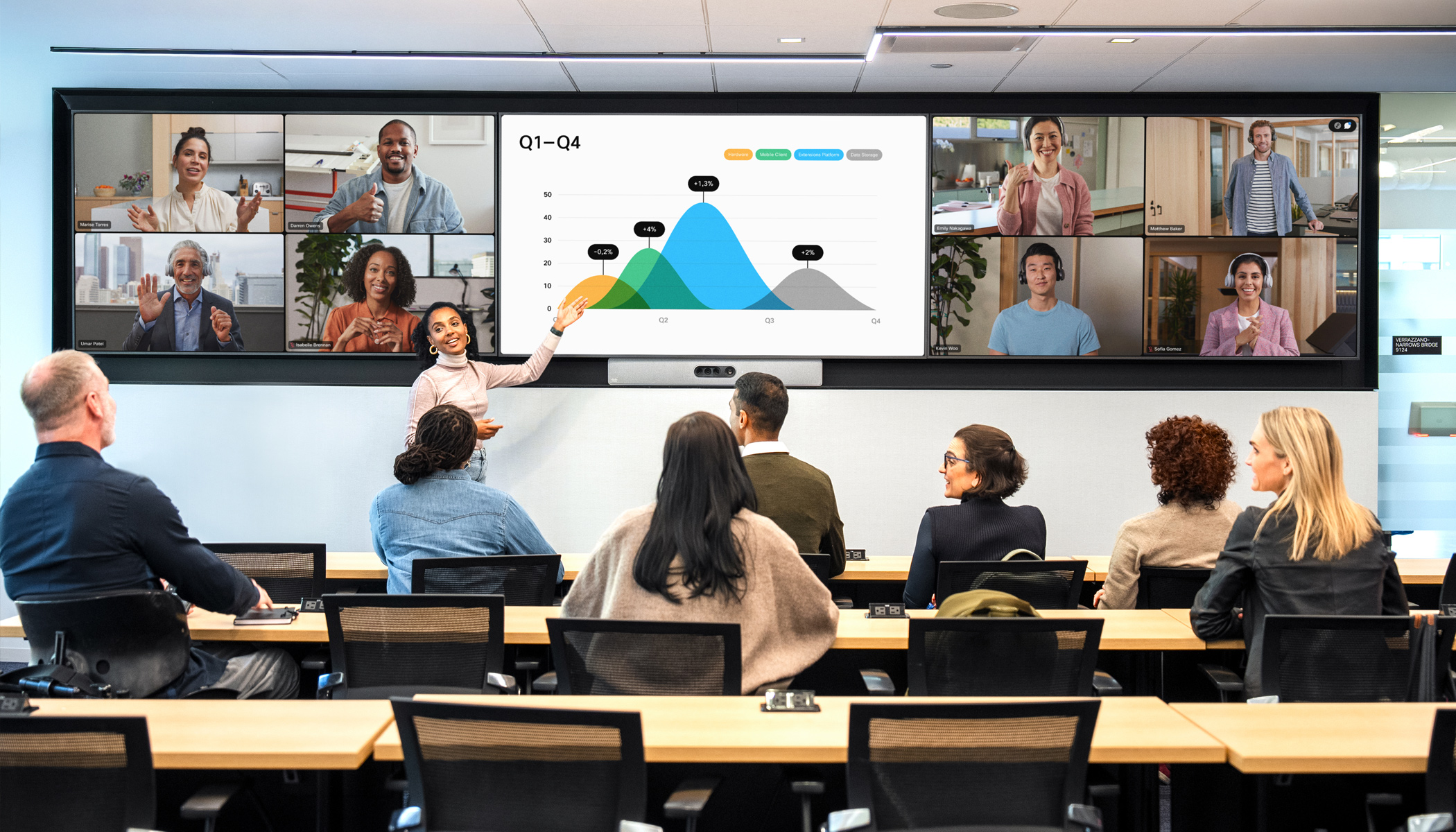
For decades, large collaboration spaces were a fragile patchwork of DSPs, extenders, and switchers from multiple vendors. Hard to deploy, impossible to manage at scale, and fundamentally incompatible with the kind of autonomous, edge-first AI the modern workplace requires. The Room Kit Pro G2 is where that architecture ends — and where a purpose-built infrastructure for intelligent work begins.
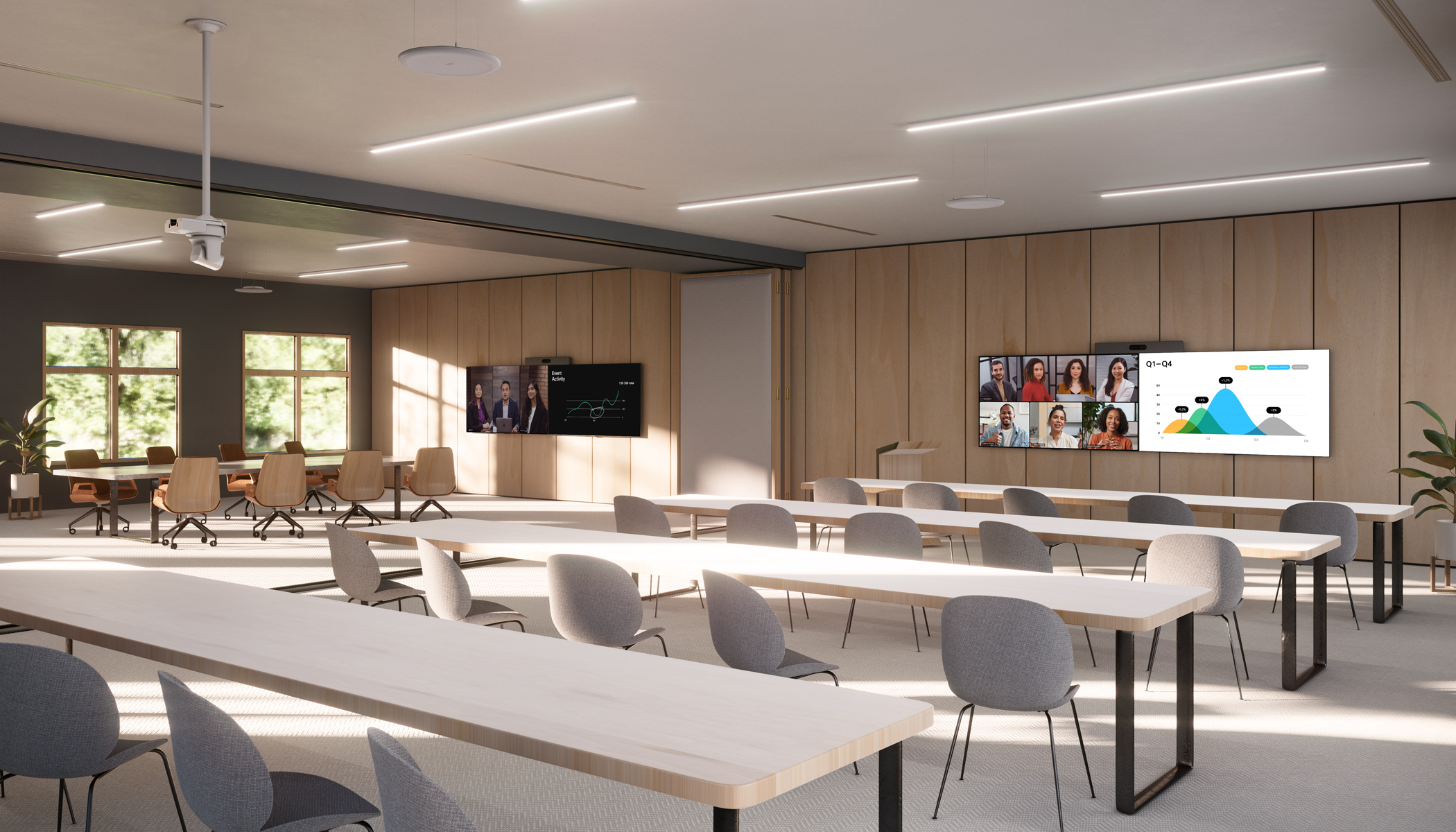
The Room Kit Pro G2 eliminates that complexity entirely. Built with a fourth-generation NVIDIA chipset delivering up to 25 times the AI processing power of its predecessor, it runs three components over a single cable: Room Vision PTZ camera, Ceiling Microphone Pro, and the compute core. One architecture, engineered for real-time spatial awareness, advanced noise removal, and people framing — all processed locally. No cloud round-trip. No latency. No sensitive data leaving the room.
The agents running on that architecture are native to the system — engineered in from the beginning. The Director Agent switches cameras, tracks speakers, and frames conversations autonomously across up to seven IP cameras and eight IP microphones. The Notetaker Agent captures and organizes action items without anyone touching a button. Translator breaks down language barriers in real time. These are not incremental improvements to a familiar product category. They represent a different category entirely — AI that acts, not AI that assists.
Announcing the Board Pro G3
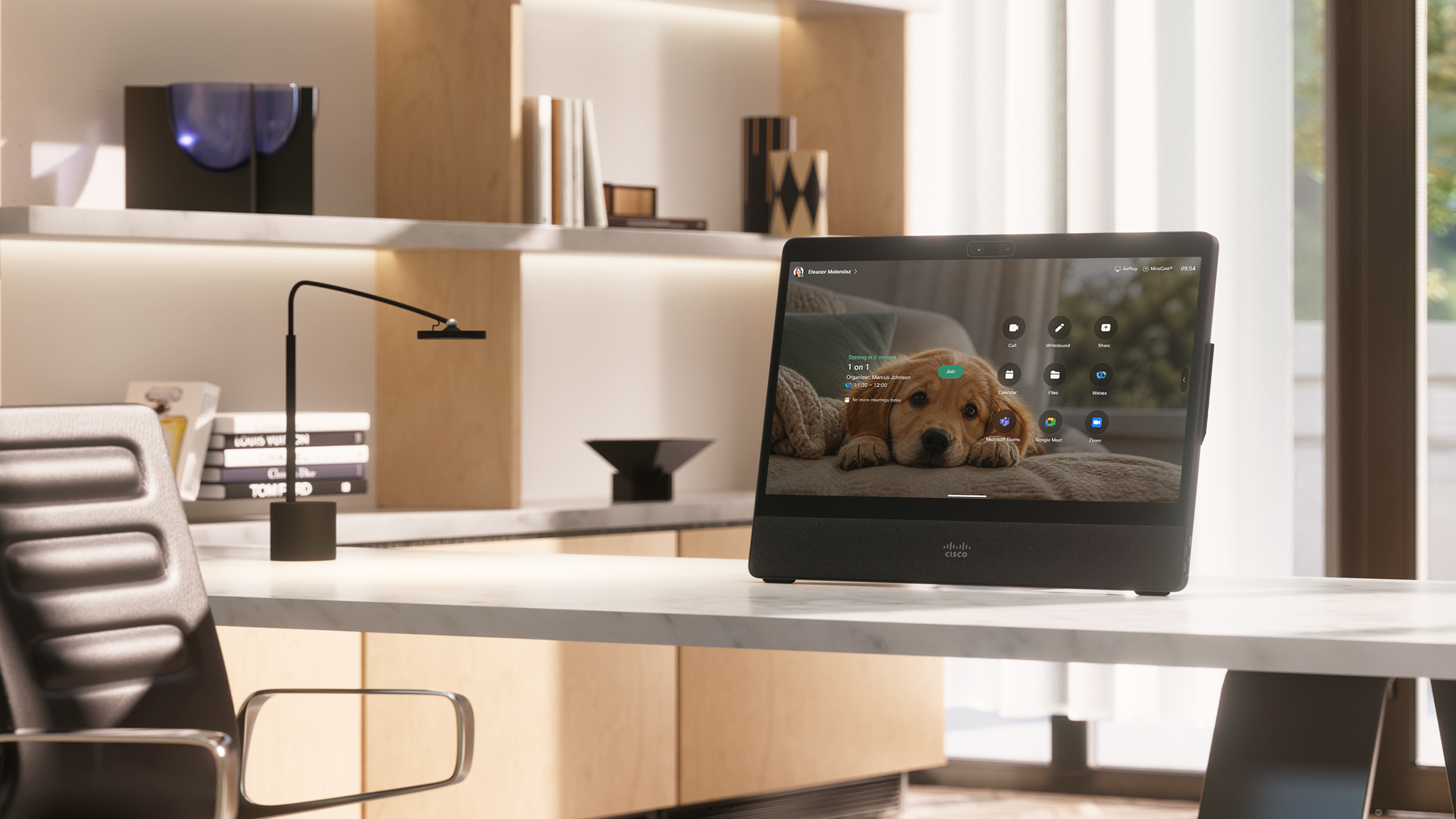
Every generation of the Board Pro has been guided by a simple principle: the space should serve the people in it. The Board Pro G3 takes that further than any previous generation.
It ships with expanded AVoIP camera and microphone support that brings visual collaboration to more spaces, and zero touch provisioning with wall, stand, and mobile mounting options. Setup that used to require specialists now takes minutes.
It is also the only MDEP (Microsoft Device Ecosystem Platform)-certified collaboration board — delivering a fully native MTR (Microsoft Teams Rooms) experience alongside Webex without compromise on either side. For organizations that have standardized on Microsoft but want the best hardware available, that certification is not a workaround. It is a first-class experience on both platforms simultaneously.
The deeper argument is about longevity. The Board Pro G3 is built on a platform designed to adopt AI models that do not exist yet. The compute, the security architecture, and the autonomous capability are all in place — no refresh required to access what comes next. Organizations buying the Board Pro G3 today are not buying a device with a three-year shelf life. They are buying a platform that evolves with the work.
Interoperability Is Not a Compromise
One of the persistent assumptions in this space is that choosing the best devices means choosing a platform. It does not. For Microsoft environments, Cisco runs MTR on RoomOS with capabilities that go beyond the standard experience: 4K content sharing, AirPlay support, and native Webex meetings when needed. The result is an 80% quarter-over-quarter increase in MTR customers deploying more than a thousand devices.
95% of those customers manage everything through Control Hub — the same platform that eliminates the three-dashboard problem entirely [Source: Cisco Internal Data]. Facilities, IT, and real estate no longer need separate tools to understand what is happening across their spaces. One platform surfaces everything: space utilization, device health, and meeting quality, owned end to end. Over 2.3 million devices are connected today [Source: Cisco Internal Data]. Each one a data point on the network, generating insight — all surfaced through a single platform now extending into AWS, Microsoft Copilot, and other environments where IT teams already work.
Smart Diagnostics delivers one-click remediation before problems reach end users. Workspace Ranking tells the team managing a thousand rooms exactly where to look at 8:45 AM when a 9:00 AM meeting is at risk.
And this week, we are excited to announce that Workspace Advisor becomes generally available. The ability to convert any room into a digital twin, configure it remotely, and make changes without anyone setting foot in the space is not a convenience feature. It is a structural shift in how IT organizations operate at scale. The CIO in Singapore should never have to send someone to that room. Workspace Advisor means they no longer have to. For teams managing globally distributed real estate with constrained headcount, this is one of the most operationally significant releases we are making this week.
Also this week, Control Hub becomes part of Cisco Cloud Control — bringing cross-domain intelligence across networking, collaboration, and security into one management and troubleshooting experience. For IT teams managing complex, multi-platform environments without additional headcount, this changes what is operationally possible. Faster resolution. Fewer escalations. A management experience that finally matches the scale of the environments it is responsible for.
Built Before the Market Asked for It
Every technology cycle arrives with new promises. The question worth asking is not whether those promises are ambitious — it is whether the infrastructure exists to deliver on them.
What I keep coming back to is this: the organizations that will get the most from AI are not the ones with the most sophisticated models. They are the ones that closed the gap between intelligence at the software layer and intelligence at the physical layer. That gap is where most AI investments quietly stall.
Cisco’s position in this market was not assembled in a product cycle. It was built over decades — the same architecture, the same conviction, every layer owned and accountable. The agentic workplace is not something we are racing toward. It is something we were already building when the conversation started.
That is what makes these announcements this week different. They are not just launches, but proof points — every layer in place, in market, and in customers’ hands. The last mile is finally here.
About The Author