Calling is mission critical, and organizations need a proven solution today with a roadmap they can trust for tomorrow. Cisco delivers this with Cisco Unified Communications Manager (UCM), the market-leading on-premises platform, Webex, a single, centrally managed cloud platform for UCaaS and CCaaS, and hybrid options for organizations that prefer to adopt innovation at their own pace.
Cisco’s market leadership and clear roadmap provide confidence at a time when some legacy calling and contact center vendors, such as Avaya and Mitel, are navigating financial pressures, complex portfolios, and shifting cloud strategies. These factors may leave customers unsure about long-term support, future innovation, and what their migration path might look like, making stability and clarity more important than ever.
Table of Contents
- Cisco: A Complete and Future-Ready Communications Portfolio
- Cisco UCM: Proven On-Premises Leadership
- Webex: A Unified Cloud Platform for Calling and Contact Center
- Webex Calling: Enterprise-Grade Cloud Calling for Global Scale
- Webex Contact Center: AI-Powered Customer Experience
- Webex Calling Hybrid: Modern Innovation + On-Premises Reliability
- Cisco Devices: A Unified Hardware Ecosystem for Premises and Cloud Calling
- Evaluating the Risks of Legacy Calling Vendors
- How Financial Instability Among Legacy Vendors Impacts Customer Risk
- Fragmented Vendor Portfolios Create Long-Term Uncertainty for Customers
- Future-proof Calling and Contact Center with Cisco
Cisco: A Complete and Future-Ready Communications Portfolio

Cisco delivers a comprehensive suite of calling and contact center solutions across on-premises, cloud, and hybrid environments. Unlike legacy vendors under financial strain and with large, unfocused product portfolios, Cisco provides customers with clarity, confidence, and a proven path forward. Our long-term commitment and clearly defined roadmap ensure that organizations can modernize at their own pace while maintaining stability, support, and continued innovation.
Cisco UCM: Proven On-Premises Leadership
At the core of Cisco’s on-premises strategy is the Cisco Unified Communications Manager (UCM) portfolio of solutions, a trusted and continuously evolving platform with decades of proven reliability. Cisco remains fully committed to the long-term innovation of UCM, investing heavily in its continued development. Since UCM 14, Cisco has introduced more than 125 portfolio enhancements, achieved 10 new government and security certifications, delivered over 300 security updates, and committed to a 10+ year innovation roadmap extending through UCM 16 and beyond.
UCM is the foundation for Cisco’s on-premises contact center solutions UCCX (Unified Contact Center Express) and UCCE (Unified Contact Center Enterprise). Together, these platforms provide flexible options to meet the needs of organizations of any size, combining reliable call control with advanced customer engagement capabilities.
Cisco’s focused on-premises strategy, centered on the UCM platform, gives customers a stable and reliable foundation for the long term. Unlike other vendors that manage multiple overlapping solutions, Cisco provides a unified, proven architecture that simplifies operations and reduces uncertainty. With UCM, customers can be confident their investment is backed by a platform built for longevity, continuous innovation, and consistent support.
Webex: A Unified Cloud Platform for Calling and Contact Center

For organizations planning a move to the cloud, Cisco offers a complete collaboration and customer experience portfolio with Webex. Built on a single platform, the Webex Suite and Webex Contact Center are centrally managed and leverage shared AI innovations and seamless integrations with the broader Cisco ecosystem including Meraki, ThousandEyes, Spaces, and Cisco Phones, Devices, and Room Systems.
Unlike legacy vendors that rely on third-party vendors for cloud services, Cisco delivers its own cloud strategy built on decades of expertise in networking, security, and real-time communications. This helps customers avoid a vendor-to-vendor migration and ensures that core calling and contact center services do not depend on outside cloud providers. The result is a clearer, more predictable, and seamless migration to the cloud on a platform fully supported and managed by Cisco.
Webex Calling: Enterprise-Grade Cloud Calling for Global Scale
Cisco delivers cloud calling with Webex Calling, an enterprise grade solution trusted by more than 18 million users globally. Available in over 195 markets with a 99.999% SLA, survivability solutions, advanced AI capabilities, and flexible PSTN connectivity options, Webex Calling provides the reliability and scale required by global businesses.
Webex Calling is available through two flexible deployment options:
- Dedicated Instance leverages the trusted Cisco UCM architecture in a private cloud environment, allowing customers to retain existing endpoints, dial plans, workflows, and survivability while gaining the benefits of cloud management and continuous innovation.
- Webex Calling multi-tenant provides full cloud agility and access to ongoing updates and AI-powered capabilities such as Webex AI Assistant, which delivers intelligent calling experiences and productivity insights, and Webex Calling Customer Assist, which enables any calling user to deliver outstanding, impactful, efficient customer service.
Webex Contact Center: AI-Powered Customer Experience
Webex Contact Center a next-generation cloud contact center solution inspired by customers and architected for business. Designed and built from its foundation as a Software-as-a-Service (SaaS) cloud solution, Webex Contact Center’s best-of-breed platform architecture brings your business the innovation, flexibility, scalability, and agility of the cloud without sacrificing security.
Webex Calling can be paired with Webex Contact Center to deliver a complete, single-platform UCaaS and CCaaS solution. This eliminates the complexity of stitching together separate communications systems, reduces integration overhead, and provides unified administration, analytics, workflows, and AI across voice and customer engagement. Organizations benefit from a consistent user experience, shared innovation, and a single point of accountability for support and service quality.
With Webex, Cisco delivers a complete cloud-ready platform for mission-critical calling and contact center services. It gives existing Cisco on-premises customers a clear and reliable path to the cloud, supported by a single-vendor solution for collaboration and customer experience. This approach provides stronger security, consistent quality, full visibility, and end-to-end accountability. The result is a predictable, enterprise-grade cloud experience backed by Cisco’s global reach and continuous innovation roadmap.
Webex Calling Hybrid: Modern Innovation + On-Premises Reliability
Cisco is a trusted provider of calling and contact center solutions for mission-critical industries such as healthcare, finance, retail, government, and defense—sectors that often require on-premises deployments due to regulatory, security, or data residency requirements. For these organizations, Cisco offers hybrid cloud solutions that allow them to remain on premises while still gaining access to modern cloud innovation. This is a key advantage of choosing a single-vendor strategy with Cisco, since Cisco owns the underlying technology and can deliver seamless hybrid deployment models.
Cisco makes it simple to bridge on-premises and cloud environments with Cloud Connected UC, which provides centralized, cloud-based administration through Control Hub. Available to Cisco UCM customers for no additional fee, Cloud-Connected UC provides businesses with a single global view of their complete on-premises calling infrastructure, centralized management and analytics, and web-based diagnostics.
Webex Calling Hybrid further extends the capabilities of Cisco UCM by delivering cloud innovations like Cloud PSTN, AI Receptionist, Customer Assist, and more. This enables customers to maintain their trusted Cisco UCM foundation on premises, while adopting the latest AI-powered cloud features where they make sense and align with business requirements.
Flexible, hybrid options underscore the strength of a single-vendor Cisco strategy. Cisco has the experience and the technology to deliver seamless transitions between on-premises and cloud environments, giving organizations confidence in a long-term, secure, and scalable path forward.
Cisco Devices: A Unified Hardware Ecosystem for Premises and Cloud Calling
Cisco offers a complete portfolio of desk phones, desk devices, room systems, headsets, wireless phones, and DECT devices. Designed and built by Cisco, they are centrally managed through Control Hub, which allows IT teams to easily provision, deploy, monitor, and update devices from a single interface.
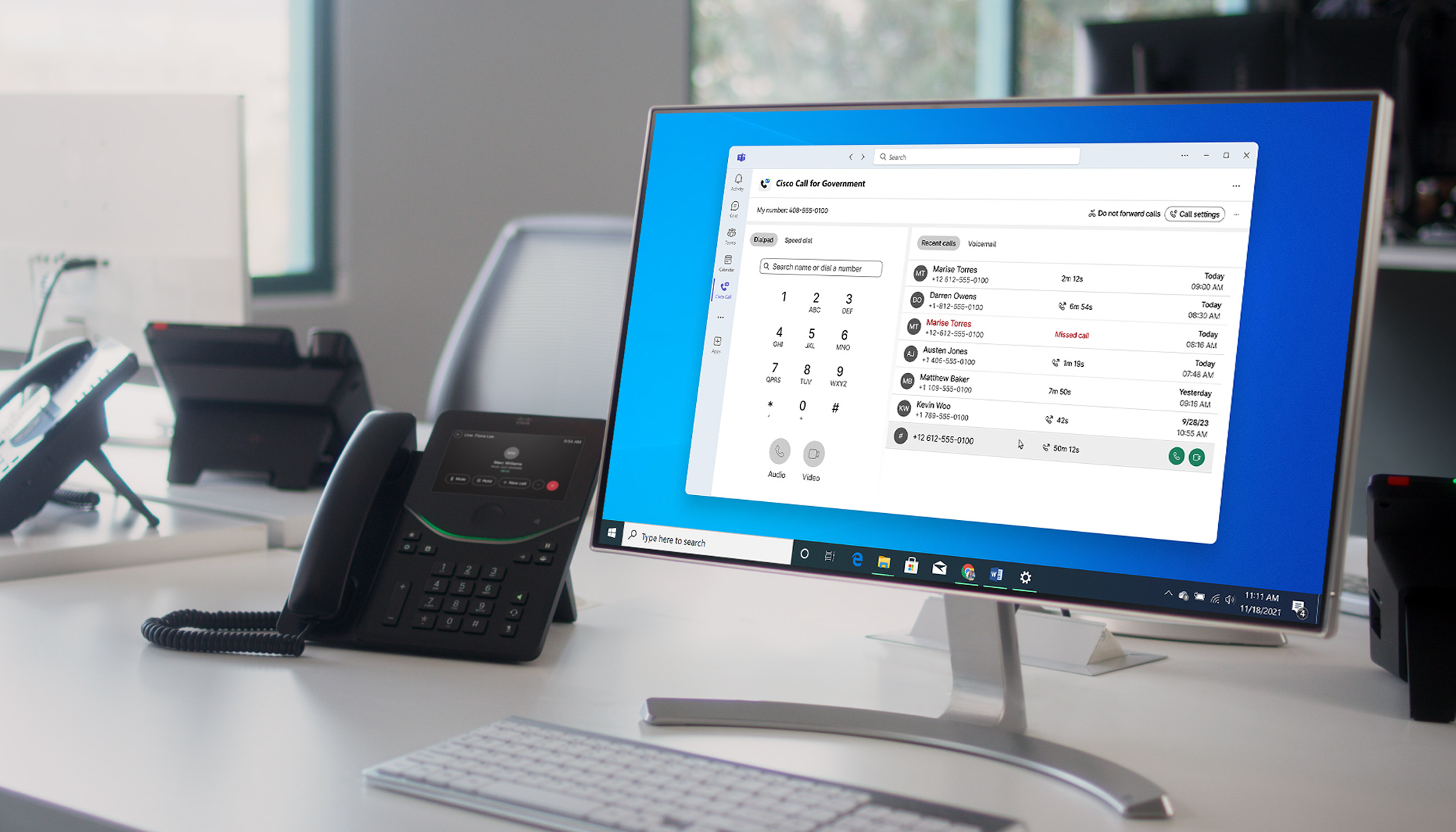
The Cisco Desk Phone 9800 Series delivers a modern desk phone experience with support for both Cisco UCM and Webex Calling. These phones provide exceptional audio quality through enhanced speakers, a bass-boosted acoustic enclosure, and AI-based noise removal that preserves high-definition voice clarity. Each device includes a customizable action button that can be configured for key use cases such as emergency calls, security access, IT support, broadcast announcements, and more. The 9800 Series offers a full range of models to fit different workspaces, including cost-effective options for common-area environments.
By delivering devices designed, built, and managed within the Cisco ecosystem, organizations gain tighter security, better performance, and a consistent experience across their collaboration estate. With Cisco, device strategy becomes simpler: one vendor, one management platform, and one seamless experience from hardware to cloud.
Evaluating the Risks of Legacy Calling Vendors

Although Cisco provides a clear and stable path for businesses operating on premises or planning a move to the cloud, the outlook may be less certain for some legacy calling and contact center vendors. Vendors such as Avaya and Mitel have faced well-publicized financial challenges and shifting cloud strategies, which can raise questions about long-term sustainability and future innovation. Businesses evaluating their communications roadmap should consider these factors as part of their planning to ensure they are positioned for the future.
How Financial Instability Among Legacy Vendors Impacts Customer Risk
The past few years have underscored the financial challenges facing legacy calling and contact center vendors. In 2023, Avaya filed for bankruptcy for the second time in six years, while Mitel filed and emerged from bankruptcy in 2025. Such instability raises critical questions about a vendor’s long-term viability and its ability to support its installed base. Avaya’s latest bankruptcy, for example, resulted in a narrowed focus of its top 1,500 global clients, leaving other customers with an uncertain future.
This financial instability is reflected in the CCC+ credit rating held by Avaya and Mitel, an indicator of high vulnerability to financial stress and elevated risk of default. A junk-level credit rating can make it difficult for vendors to raise additional financing, invest in new technologies, or maintain the pace of innovation and service that customers depend on.
Fragmented Vendor Portfolios Create Long-Term Uncertainty for Customers
Beyond financial pressures, Avaya and Mitel manage sprawling portfolios that include multiple, often acquired platforms. This complexity can be costly to maintain and make lifecycle management and long-term support more challenging for customers. In addition, both vendors rely on third party partners for cloud collaboration, which may introduce additional considerations for customers planning a migration or cloud strategy.
Avaya maintains a complex mix of calling and contact center solutions, including IP Office and Aura. In 2024, it introduced the Infinity platform, which relies on technology acquired from Edify, marking yet another strategic shift that relies on a different technology stack. The company’s cloud strategy relies on a third-party OEM agreement with RingCentral. For customers, this patchwork of platforms creates uncertainty, and Avaya’s multi-vendor strategy complicates migrations and long-term planning.
Mitel faces similar challenges, managing acquired platforms from ShoreTel, Aastra, and Siemens/Atos alongside its proprietary MiVoice Business, MiCollab, MiContact Center, and MiVoice Office 250 products. Maintaining multiple overlapping systems amid financial pressure is difficult and can leave customers uncertain about future roadmap. Mitel’s cloud strategy has also shifted repeatedly, moving from a partnership with RingCentral in 2021 to a new UCaaS relationship with Zoom in 2024, further eroding confidence among customers and partners seeking stability.
Avaya and Mitel customers face risk from fragmented product portfolios and reliance on third parties for cloud innovation. These factors compound existing financial instability, creating uncertainty around product longevity, cloud migration paths, and long-term vendor viability.
To learn more about the risks of remaining with a legacy premises vendor, check out our on demand webinar – Legacy Calling is Holding You Back: How to Future-Proof Communications with Cisco.
Future-proof Calling and Contact Center with Cisco
Calling and Contact Center are mission critical. As communications needs continue to evolve, organizations cannot afford uncertainty, fragmented architectures, or vendors without a clear path to the future. Cisco delivers a complete, future-ready solution across on-premises, cloud, and hybrid deployments backed by financial stability, a unified product portfolio, global scale, and a long-term innovation roadmap. Whether maintaining mission-critical operations on premises, embracing the cloud, or taking a gradual hybrid approach, Cisco gives customers a secure, reliable, and predictable strategy they can trust for the next decade and beyond. Cisco is not just a safer long-term choice—it’s a strategic advantage that allows businesses to modernize on their terms, without compromise. Ready to modernize your communications strategy? Contact us to get started.
Learn more:
About The Author