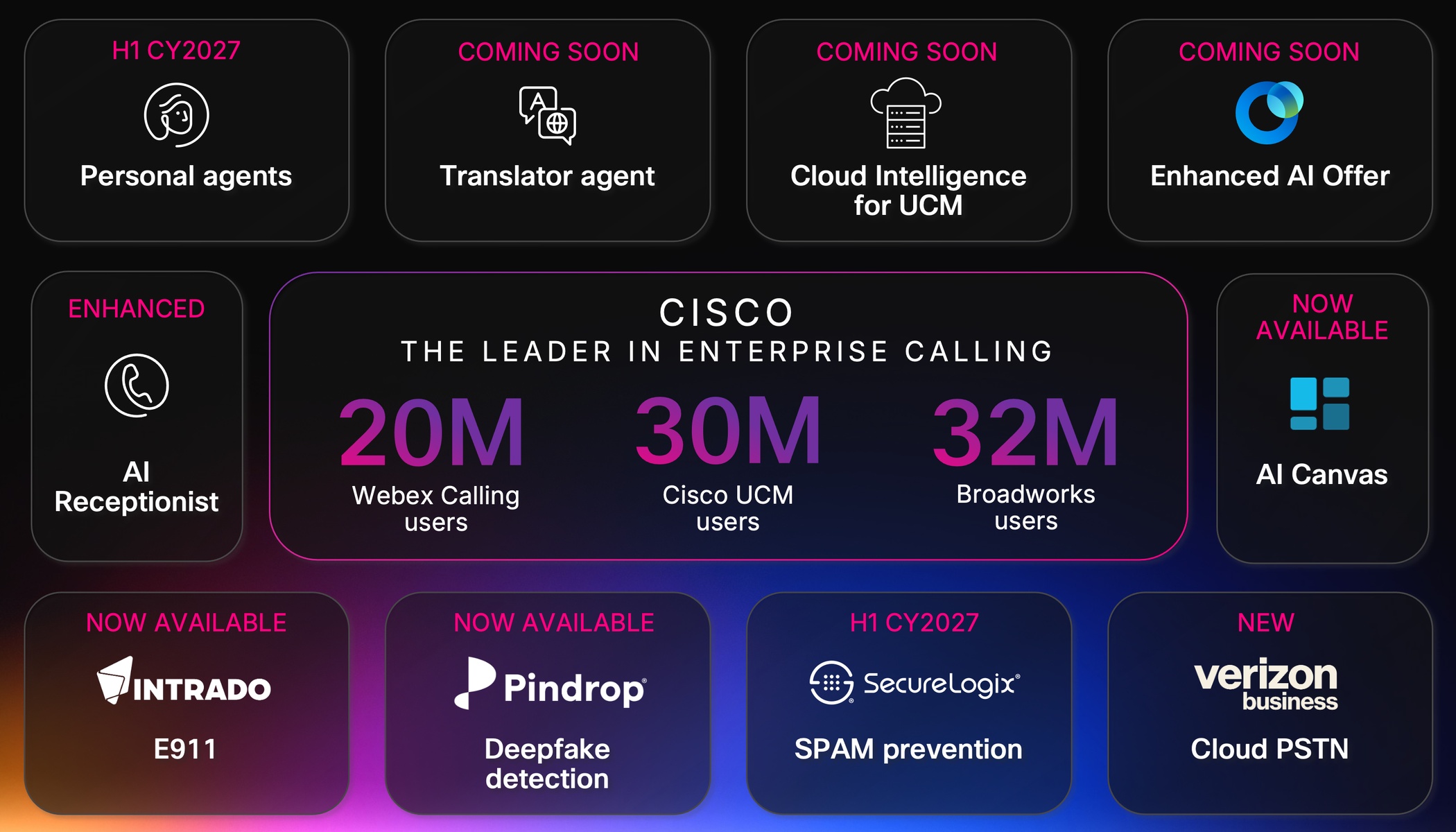
Enterprises rely on Cisco UCM as a trusted foundation for business-critical communications, and they want to build on that foundation with cloud-powered AI and innovation. But regulatory requirements, operational dependencies, and migration timelines can make a full move to the cloud impractical. Organizations need a way to extend the benefits of the cloud to their UCM environments while maintaining the control, continuity, and resilience they depend on, with the flexibility to determine where, when, and how they modernize.
Today, we’re excited to unveil Cloud Intelligence for UCM, bringing cloud-powered AI and innovation to user, customer, and administrator experiences while retaining UCM call control. It gives organizations a new path to modernization that preserves the flexibility and control to move at their own pace.
Modernize without compromising control
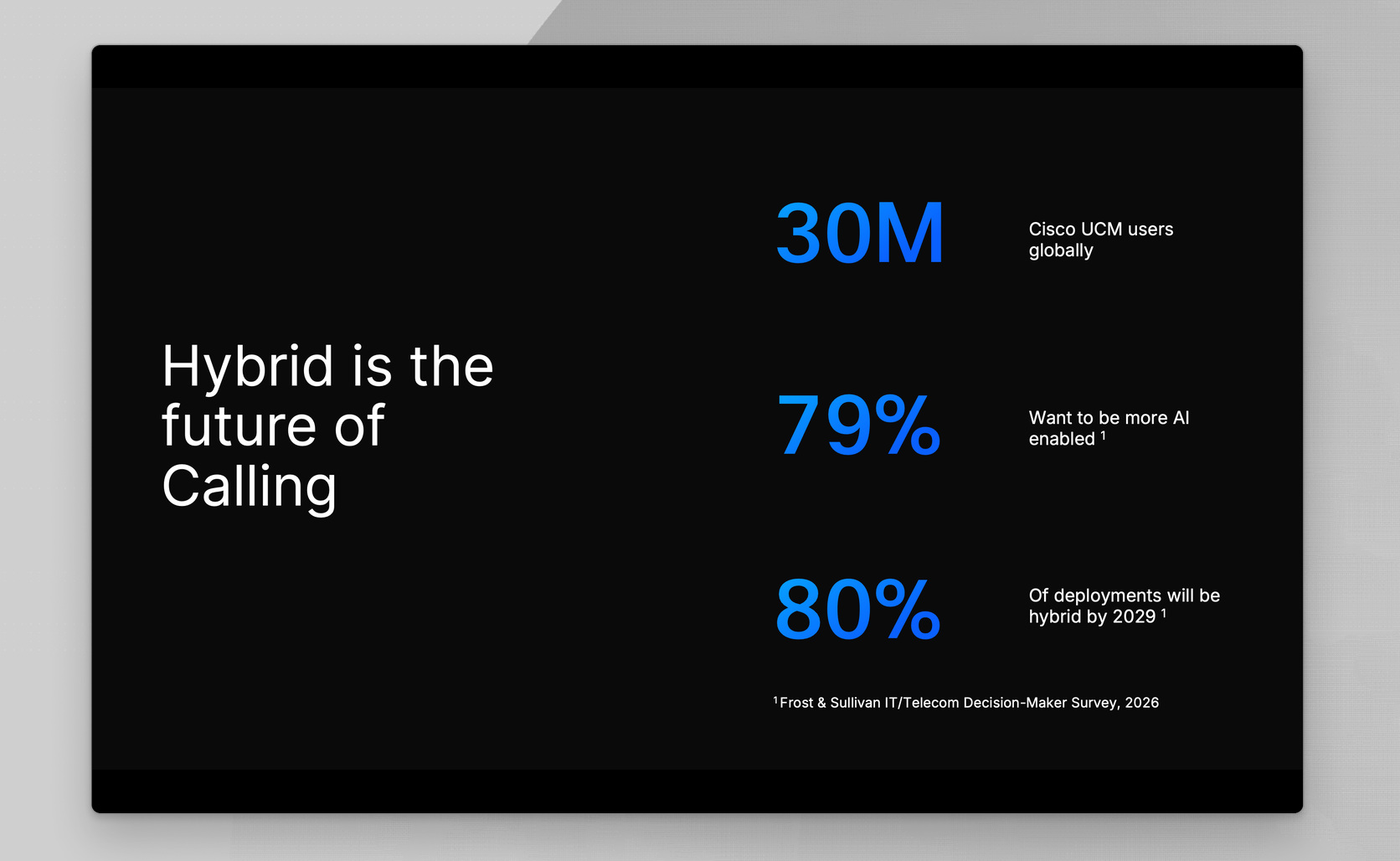
More than 30 million people rely on Cisco UCM for business-critical communications. For many organizations, UCM is an integral part of their operations, supporting critical workflows, applications, devices, and compliance requirements. Cisco remains firmly committed to UCM and its continued evolution, with versions 16 and 17 extending the platform’s roadmap well into the next decade.
At the same time, IT leaders are navigating a period of rapid change. AI and cloud innovation are creating new opportunities to transform communications, and 79% of IT and telecom leaders are looking to become more AI-enabled. The challenge is how to take advantage of that innovation while preserving the resilience, control, and continuity their businesses depend on.
Traditionally, accessing the latest cloud and AI capabilities has meant migrating calling to the cloud. But for many organizations, operational dependencies, regulatory requirements, local survivability, and geopolitical considerations make maintaining on-premises calling an important part of their long-term strategy.
Hybrid architectures offer another path, bringing cloud innovation to on-premises environments without requiring a full migration. By 2029, 80% of calling deployments are expected to rely on hybrid architectures, giving organizations greater flexibility to determine where, when, and how they modernize while continuing to build on their UCM investments.
Introducing Cloud Intelligence for UCM
Cloud Intelligence for UCM provides a new path to modernization, extending the UCM calling foundation with cloud services, AI-powered experiences, simplified administration, and intelligent operations without requiring organizations to move calling to the cloud. Customers can modernize user and administrator experiences while preserving their existing UCM investments and operational control. They can maintain this hybrid architecture for the long term or move users, sites, or regions to Webex Calling whenever it makes sense for their business.
Modernization begins with the employee and customer experience
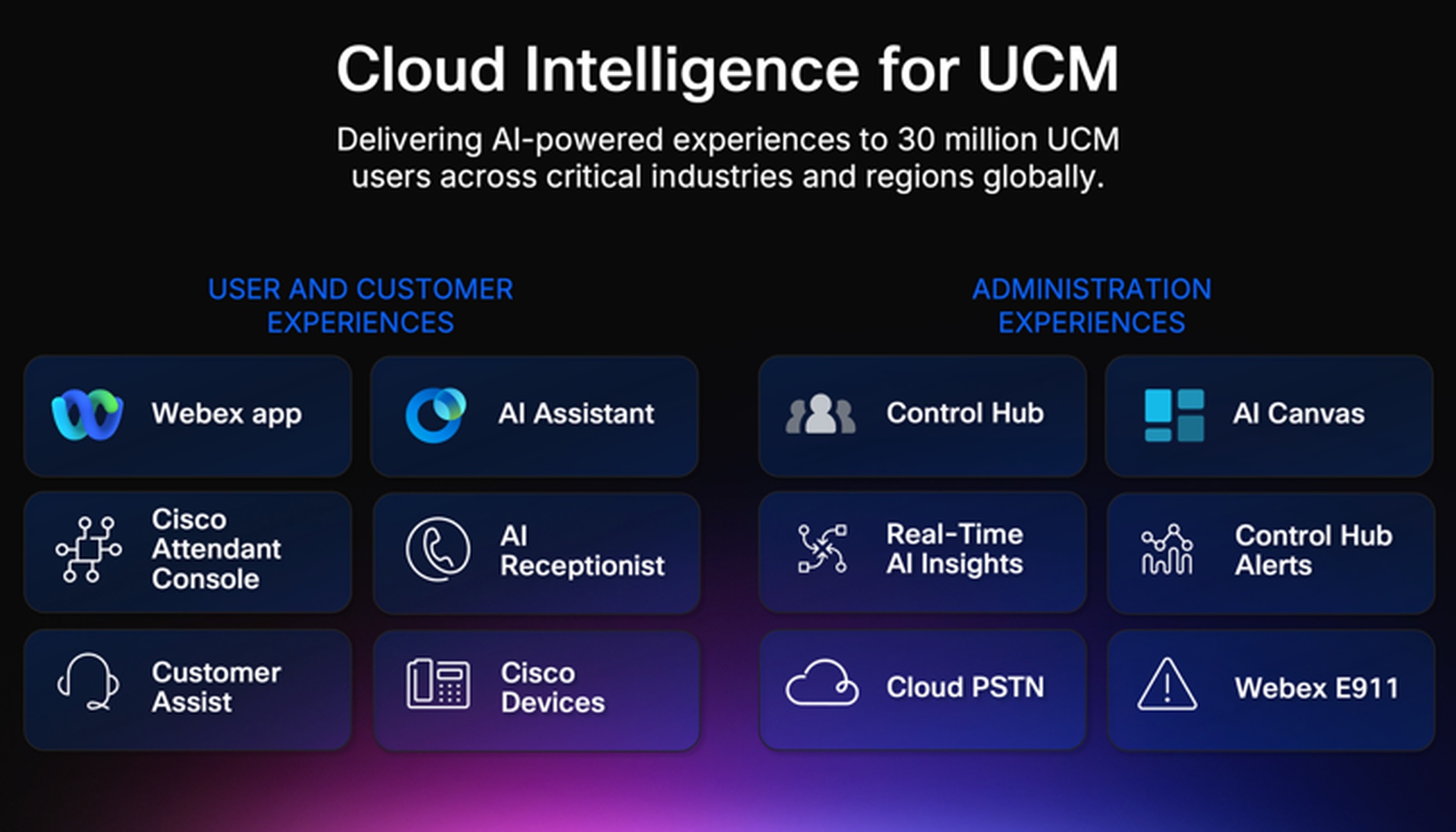
Cloud Intelligence for UCM brings the Webex Calling Professional feature set to UCM users through the Webex App, delivering a modern, AI-powered experience while retaining UCM call control.
Users gain advanced calling, messaging, meetings, voicemail and transcription, recordings, business texting, multiline capabilities, device control, and more in a single app. For organizations using Jabber today, Webex App provides a significant evolution in the employee experience while allowing them to maintain their existing UCM architecture for as long as it meets their needs.
Elevate productivity with AI Assistant
Cloud Intelligence brings AI directly into the daily calling experience for UCM users. With Cisco AI Assistant for Calling, employees can access capabilities such as closed captions, translations, transcripts, live and post-call summaries, notes, and action items. Rather than focusing on capturing every detail, employees can stay present in the conversation, quickly understand what matters, and leave every call with the insights and next steps they need to take action.
Transform customer interactions with AI Receptionist and Customer Assist
Cloud Intelligence for UCM extends AI beyond the employee experience and into customer interactions. AI Receptionist uses natural-language conversations to answer routine questions, provide information from a business knowledge base, understand caller intent, and intelligently connect callers to the right person or team. Organizations can deliver faster, more responsive service while giving employees more time to focus on interactions where a human can add the most value.
Customer Assist brings customer-service capabilities to local branches, retail stores, medical clinics, and other distributed teams without the cost and complexity of a full contact center. Through the Webex App they already use for calling and collaboration, employees can access queues, AI assistance, supervisor capabilities, and analytics to serve customers where local knowledge and expertise matter most.
Customer Assist can also complement a centralized contact center, enabling local teams to handle interactions best suited to their expertise while specialized contact-center teams manage broader or more complex needs.
Simplify the administrator experience

Modernization should simplify operations, not add complexity. Cloud Intelligence for UCM brings cloud management and intelligence to hybrid calling environments, giving IT teams greater visibility and a more unified way to manage, monitor, and optimize operations. With fewer tools to navigate and greater intelligence across the environment, teams can identify issues earlier, resolve them faster, and spend more time improving service quality.
Move from reactive troubleshooting to intelligent operations

Traditional troubleshooting often begins after a user reports a problem. Cloud Intelligence for UCM changes that model by helping IT teams identify and understand issues before they become widespread.
Real-Time AI Insights learns normal calling behavior across the organization, including call volumes, failures, registrations, system health, regional patterns, and other operational conditions. When meaningful deviations occur, it can identify anomalies, correlate them with application alerts, and recommend actions to accelerate investigation.
Control Hub Alert Center brings alerts from supported Cisco UC applications into a centralized experience. Administrators can create granular rules based on application, cluster, and severity, with notifications delivered through Webex App, email, or webhooks.
For more complex issues, AI Canvas brings evidence from Cisco domains including ThousandEyes, Meraki, and Control Hub into a conversational workspace. Administrators can investigate using natural-language questions, correlate signals across domains, identify likely root causes, and maintain context as issues move between teams.
Together, these capabilities move IT operations toward earlier detection, faster diagnosis, and more intelligent resolution.
Reduce operating costs and infrastructure complexity

Cloud Intelligence for UCM can also simplify the infrastructure and processes surrounding UCM. By moving supporting services to the cloud while retaining UCM call control, organizations can reduce infrastructure, streamline operations, and gain greater agility.
Simplify PSTN infrastructure and increase agility
Cloud-based PSTN provides another path to modernization without changing UCM call control. Cisco Calling Plans for UCM provide Cisco-managed PSTN through Control Hub, with centralized management, reporting, analytics, and billing across UCM and Webex Calling. Metered options allow organizations to pay for the numbers they provision and the minutes they use.
For greater provider choice, Cloud Connect for UCM extends cloud PSTN through certified Webex Calling partners across more than 70 markets. Organizations can choose providers based on coverage, pricing, and service requirements and introduce cloud PSTN site by site, reducing reliance on premises-based infrastructure while maintaining deployment flexibility.
Reduce operational overhead and specialized infrastructure
Cloud Intelligence can further reduce the day-to-day effort required to operate UCM. Centralized administration, cloud monitoring, proactive AI insights, and AI-assisted troubleshooting help automate routine work and accelerate issue resolution.
Cloud-delivered services can also replace infrastructure that previously required dedicated systems. For example, the roadmap extends Webex Location Information Server to UCM, bringing emergency location management into Control Hub and reducing reliance on third-party emergency services and Cisco Emergency Responder.
The result is a leaner operating model with less infrastructure to maintain, less administrative overhead, and more time for IT teams to focus on strategic priorities.
Flexible licensing that lets you modernize on your terms
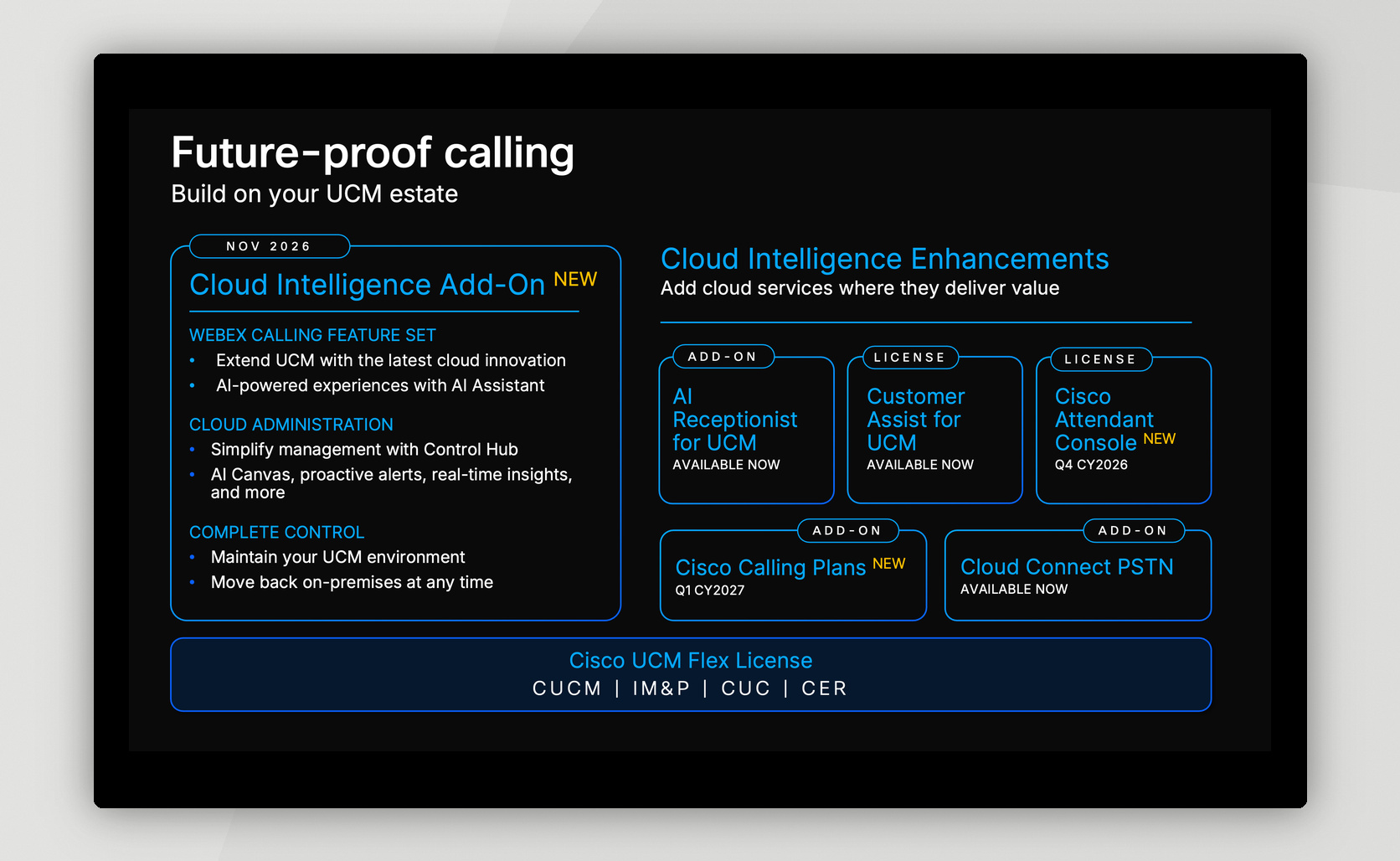
Cloud Intelligence for UCM builds on the UCM foundation, allowing organizations to introduce cloud capabilities incrementally based on their priorities and modernization plans. The Cloud Intelligence add-on brings the Webex Calling feature set and cloud administration to UCM users while retaining UCM call control.
Organizations can also choose from services including AI Receptionist, Customer Assist, Cisco Attendant Console, Cisco Calling Plans, and Cloud Connect for UCM, with more on the roadmap. These services can be adopted independently of the Cloud Intelligence add-on and of one another, giving organizations the flexibility to mix and match based on their needs without requiring every site, user, or workload to modernize at the same time.
This flexible approach also makes modernization more cost effective. Organizations can make targeted, incremental investments rather than taking on the cost and complexity of a large-scale transformation. Those investments can deliver value through greater automation, reduced infrastructure and operational costs, and improved productivity. The result is a modernization model that lets organizations invest where the business case is strongest today and expand as value is realized.
Modernize today, move when you are ready
UCM customers should not have to choose between the calling foundation they trust today and the innovation they need for tomorrow. Cloud Intelligence for UCM brings those priorities together, giving organizations the flexibility to modernize experiences, introduce AI and cloud innovation, and simplify operations while maintaining the control, continuity, and resilience their business depends on.
Modernize on your terms. Maintain UCM for as long as it makes sense for your business, introduce cloud capabilities where they create value, and move users, sites, or regions to Webex Calling only when you are ready.
Want to see what this looks like in practice? Join our upcoming Cloud Intelligence for UCM webinar to see the latest capabilities in action, hear how Cisco is bringing AI and cloud innovation to UCM, and learn how you can build a modernization strategy that works for your organization.
Learn more
Cloud Intelligence for UCM At-a-glance
About The Authors