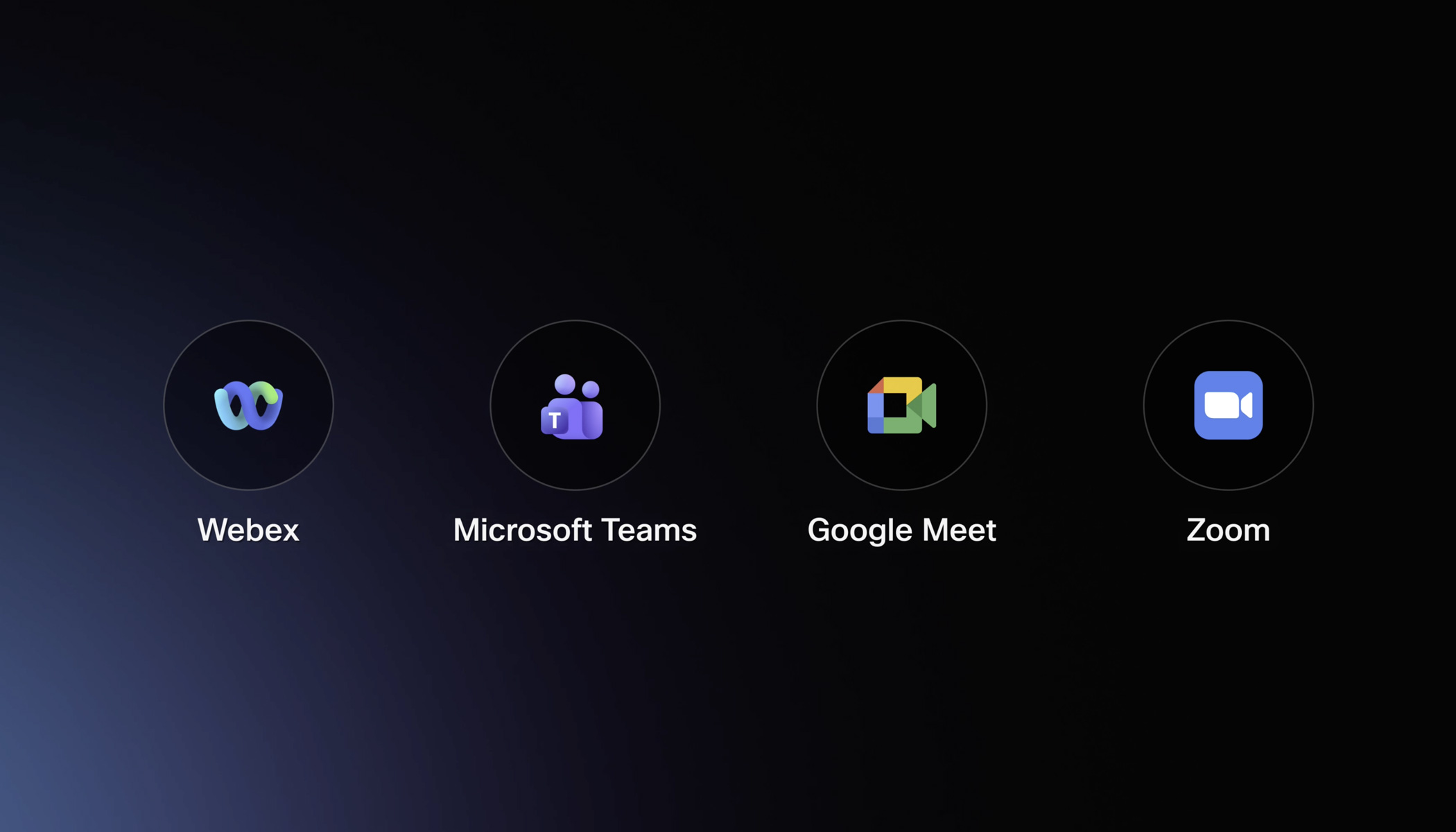
The agentic workplace shouldn’t depend on which meeting platform you run.
It’s been a busy few months for Cisco Collaboration Devices. At ISE 2026 we shipped the Cisco Desk Pro G2 and Room Kit Pro G2 — both built with the ability to run the Microsoft Device Ecosystem Platform (MDEP) for Microsoft Teams Rooms (MTR) experience, both in market today. Just two weeks ago, at Cisco Live US 2026, Espen Løberg introduced the Cisco Board Pro G3 — our first MTR Certified board powered by MDEP, purpose-built for the agentic workplace.
This week at InfoComm 2026, we’re extending that work in a direction I want to spend a little time on: interoperability, and what it really means in an agentic-workplace world.
Most of the customers I spend my time with don’t live in a single-vendor world. They may have one primary platform, but across their global estates it’s not unusual to find Webex, Microsoft Teams, Zoom, and Google Meet all running side-by-side — because that’s what their employees, their customers, and their partners actually use. And every one of those customers is now layering AI on top of all of it.
The principle we keep coming back to is a simple one: the meeting platform you choose shouldn’t decide whether you get to unlock the agentic workplace. The workplace experiences you get should travel with you as you move from one workspace to another, regardless of the devices you use and not solely dependent on the meeting platform running on top them.
That’s the theme of our InfoComm 2026 updates. Consistent Cisco hardware experience. Consistent Cisco cloud management experience. Same agentic workplace experience. Whichever platforms —Webex, Microsoft Teams, Zoom, or Google Meet — your organization has chosen.
The Agentic Director and Workspace Advisor agents in RoomOS 26 are already supported for our Webex and Microsoft Teams Rooms customers. are a couple of other enhancements we’re making.
Microsoft Teams Rooms: native experience, Cisco scale
Microsoft Teams Rooms on Cisco isn’t about hardware compatibility — it’s about giving Microsoft customers the operational experience they’ve been quietly asking for: the breadth of the Cisco device portfolio, the depth of Cisco’s management cloud, and the AI we run on top of both — without losing a single feature on the Microsoft side.
Here are a few things we have recently released that add to Microsoft Teams Rooms customers:
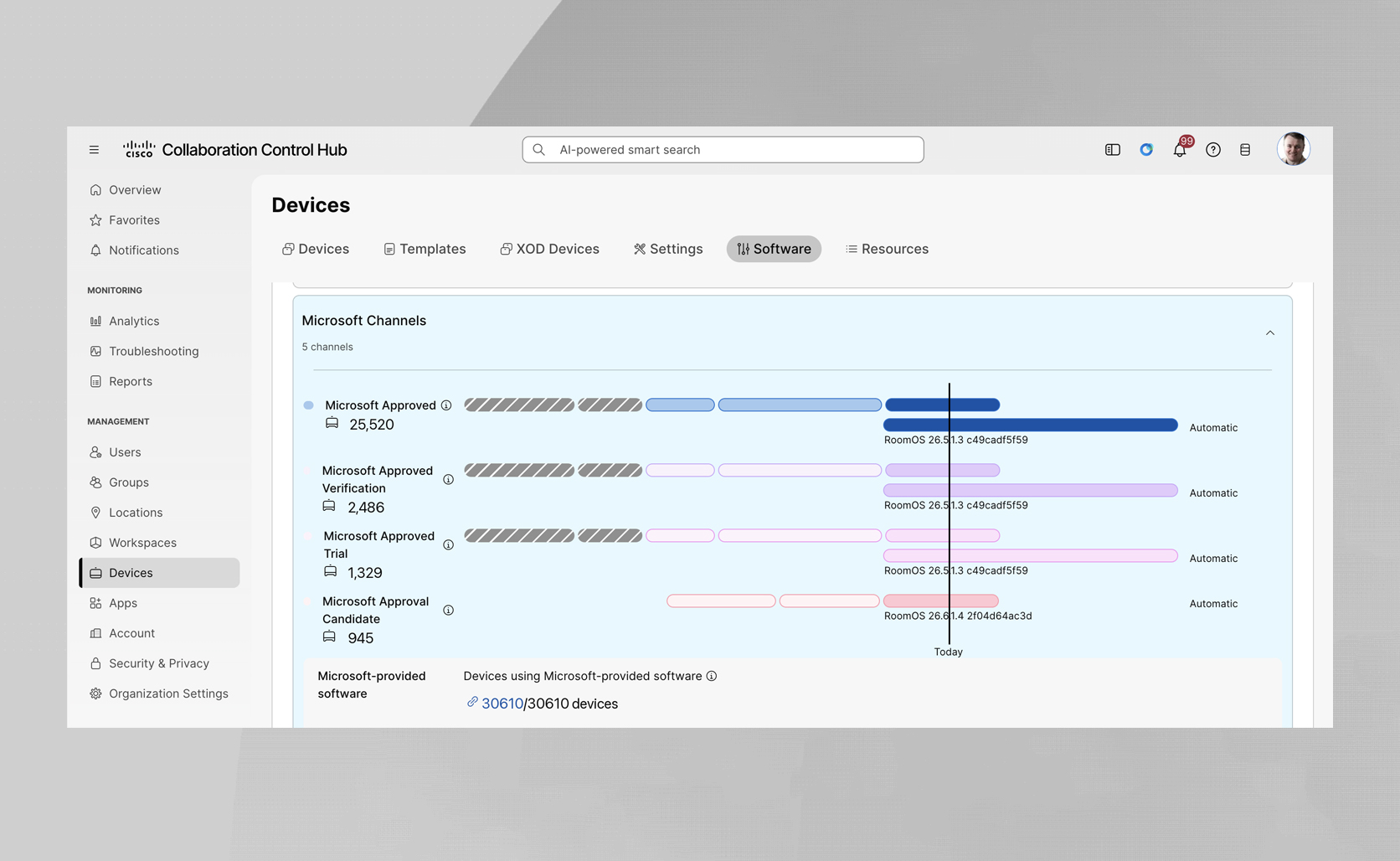
Four new dedicated channels for managing MTR devices in Control Hub. Most customers running Microsoft Teams Rooms at scale have lived with a fragmented release pipeline — production, validation, trial, and Microsoft-approved candidate builds, each managed in different places. Starting at InfoComm we’re bringing all four — Microsoft Approved, Microsoft Verification, Trial, and Microsoft Approval Candidate — into Control Hub as first-class device channels. One pane of glass. Same workflow customers already use for RoomOS. Pre-deployment validation that no longer requires a separate environment to run.
AgenticOps, extending with Copilot (in beta). Our customers don’t want to operate Microsoft and Cisco as two different worlds. With Cisco Cloud Control now bringing Collaboration Control Hub into the broader Cisco management fabric, IT teams can pull Cisco workspace data into the Microsoft 365 environment they already work in — using Copilot to interrogate room health, meeting quality, and workspace utilization in natural language, alongside the rest of their tenant. The AI doesn’t replace the operator. It removes the swivel-chair.
Operate consistently. Deploy at scale. Move from reactive to proactive in the workplace. That’s the value of running Microsoft Teams Rooms on Cisco.
Coming soon: Cisco Devices for Zoom Rooms
Prior to ISE 2026 we announced Zoom for Cisco Rooms — bringing a high-quality, native Zoom meeting experience to customers who deploy our devices in the Cisco Rooms experience, far beyond what traditional SIP/H.323 (Zoom CRC) interop ever delivered. The reception was clear: customers want a serious, supported answer for running Zoom on Cisco hardware, and they want it to feel like a Zoom meeting — not an interop bridge and we delivered.
Today, we’re excited to take our collaboration with Zoom one step further by seeking certification for Zoom Rooms. This new option means that select Cisco Collaboration Devices will be — perfect for organizations that have standardized on Zoom and want a Zoom-centric experience from the moment they walk into a workspace, starting with a familiar Zoom Rooms home screen.

When certified, a broad range of Cisco devices will enable admins to provide a consistent Zoom experience in every workspace – from the desk and huddle spaces (with Cisco Desk Pro G2) to everyday meeting rooms (with Cisco Room Bar or Bar Pro), from creative brainstorming and ideation spaces with the Cisco Board Pro G3) to large conference rooms, training suites or classrooms and auditoriums (with Room Kit Pro G2).
Other Cisco features customers get when running the Zoom Rooms application on Cisco Devices, powered by Cisco RoomOS include:
- Agentic Director — camera intelligence built-into our devices that understands the context of a meeting, automatically frames people or groups of people to give the best view possible at any moment, in any space, from multiple camera sources – without the end-user having to change any settings or camera modes.
- Best-in-class workspace management — In addition to Zoom Device Management, admins can manage their devices through Cisco Collaboration Control Hub. They get additional workspace-level visibility, telemetry, and insights, helping scale video deployments across the entire organization.
- Cisco ThousandEyes inside the room — ThousandEyes agents running on Cisco devices mean you no longer need to guess if a quality issue is down to a network issue – you know, with hop-by-hop view of the network path, available via Control Hub. So, reports of a poor meeting on a Tuesday morning is something you can understand and act on immediately.
- A digital twin with Workspace Advisor — the same capability all our device customers benefit from, now also available with Cisco Devices for Zoom Rooms. AI built into our devices generates a digital twin of your workspace in Control Hub that allows you to understand and in many cases remedy Day 2+ issues without ever having to send an engineer to site.
With this announcement, the Zoom hardware partner ecosystem for Zoom Rooms can expand with one of the most trusted and widely deployed hardware brands in enterprise IT. For Cisco, this announcement marks the next step in its strategy to deliver the best possible experiences with its devices across leading collaboration platforms.

Cisco Devices for Zoom Rooms
The public beta of Cisco Devices for Zoom Rooms will start during June 2026, with general availability expected September 2026.
Google Meet: sharing the way people actually share
Not every meeting starts with screen share. A lot of them start with a colleague walking in, sitting down, talking and then.. “Let me show you something”
For customers on Cisco RoomOS devices that moment used to mean reaching for a cable or connecting to Miracast or AirPlay, but until recently that was not possible in a Google Meet meeting on Cisco hardware. Our Google Meet WebRTC experience on RoomOS now supports the full range of sharing options Cisco customers expect — HDMI, Miracast, and AirPlay and more — so anyone walking into the room and joining a Google Meet call can share from the device, the way they already share in every other Cisco room they walk into.
The breadth, depth, and simplicity no one else can match
Step back from the individual announcements and the picture is the one we’ve been working toward for years.
One Device. Every major meeting platform.
- Webex – fully featured Webex meetings running natively on Cisco devices however you deploy them.
- Microsoft Teams Rooms — natively, built on MDEP, with the Cisco Director Agent and Copilot Facilitator running inside it.
- Zoom — both as Zoom for Cisco Rooms and, as of September 2026, as a certified Cisco Device for Zoom Rooms running on Cisco hardware.
- Google Meet — an enhanced WebRTC experience with the full sharing experience our customers already rely on.
One agentic workplace experience. The Director Agent doesn’t care which meeting platform the call is on. The local Notetaker doesn’t care. The room-level audio intelligence doesn’t care. The agentic workplace travels with the device, not the meeting platform.
One management plane. Cisco Cloud Control with Collaboration Control Hub — working alongside whichever admin tool each platform brings, not against it — surfacing Smart Diagnostics, Workspace Ranking, Workspace Advisor, ThousandEyes, and the rest of the Cisco operational fabric across every device, regardless of the meeting platform it’s running.
That breadth comes from something fairly specific to Cisco: we deliver and end to end experience, the operating system, the workplace management platform, and the network — and we’ve invested in deep partnerships with each of the major meeting platforms. Few vendors are positioned to bring all of that together at the same time.
If you’ve read Espen Løberg’s recent blog post on the last mile of AI infrastructure, you’ll have seen the architectural argument: Cisco owns every layer required to deliver an agentic workplace — the network, the device, the platform, and the intelligence. What InfoComm 2026 makes clear is that that same architecture extends across every meeting platform our customers run. Not as compatibility. Not as a workaround. As a first-class experience, on day one, with the AI and the management-built in.
Choosing the best devices shouldn’t mean choosing the platform. Standardizing on a meeting platform shouldn’t mean compromising on the workspace. The agentic workplace is something every employee should experience — whether they meet on Webex, Microsoft Teams, Zoom, or Google Meet.
Attending InfoComm?
17-19 June, Las Vegas Convention Center.
Visit the Cisco booth (#C5107).
We have a lot more coming. The breadth of the partnerships we’re opening, the depth of the agents we’re running on the edge, and the operational fabric we’re bringing to IT teams managing thousands of rooms — across multiple meeting platforms, across multiple geographies, with constrained headcount — is, honestly, the most exciting product runway I’ve worked on in my career.
About The Author