Contact center quality management is at an inflection point. For years, organizations have operated with a fundamental blind spot, reviewing 2 to 3 percent of their interactions and making decisions about agent performance, customer experience, and compliance based on that narrow sample.
The business and IT leaders we work with are no longer willing to accept that limitation. And increasingly, they do not have to.
According to the Cisco AI Readiness Index 2025, 83 percent of organizations plan to develop or deploy AI agents. Yet fewer than a third feel fully equipped to secure and govern those agents once they go live. That gap is not theoretical, it is the reality contact center leaders are planning for right now. And it is a reality that traditional quality management frameworks were never built to address.
Quality Management Is Not a Feature
The way quality management has been positioned, as a module, a compliance tool, a call recording add-on has shaped how organizations think about it, budget for it, and limit it.
What quality management actually needs to be is a quality intelligence suite: a set of capabilities working together to give customer experience leaders complete, continuous, real-time visibility into every interaction. Not 2 percent. Not 3 percent. All of them.
Those capabilities are real-time transcription, sentiment analysis, AI evaluation scoring, speech analytics, and coaching insights. Individually, each delivers value. Together, they create something that none of them can produce alone.
The Problem With Seeing Only 3 Percent
When an organization reviews 3 percent of its interactions and calls it “Quality management”, it is not managing quality. It is managing its sample.
And samples have a bias problem. The interactions that get reviewed tend to be accessible and manageable. The ones that reveal the most complex conversations, edge cases, the subtle moments where something went wrong are exactly the ones most likely to fall outside the sample.
The result is a quality management system that is structurally optimized to confirm that things are going well. Scores stay healthy. Trends look positive. And the other 97 percent of interactions the ones that contain the real story of the contact center remain invisible.
Consider what 2 to 3 percent coverage actually means in practice. Across the deployments we see, manual QM often reviews fewer than one percent of the interactions a contact center actually handles. The remainder, the overwhelming majority of customer conversations goes entirely unassessed. Every one of them holds potential coaching opportunities, compliance signals, and customer experience insights that no supervisor will ever see.
Turning on AI-driven quality management across 100 percent of interactions is like turning the lights on in a room you thought you knew.
What Changes When You See Everything
When organizations move from fractional sampling to full coverage, the shift is immediate and consequential.
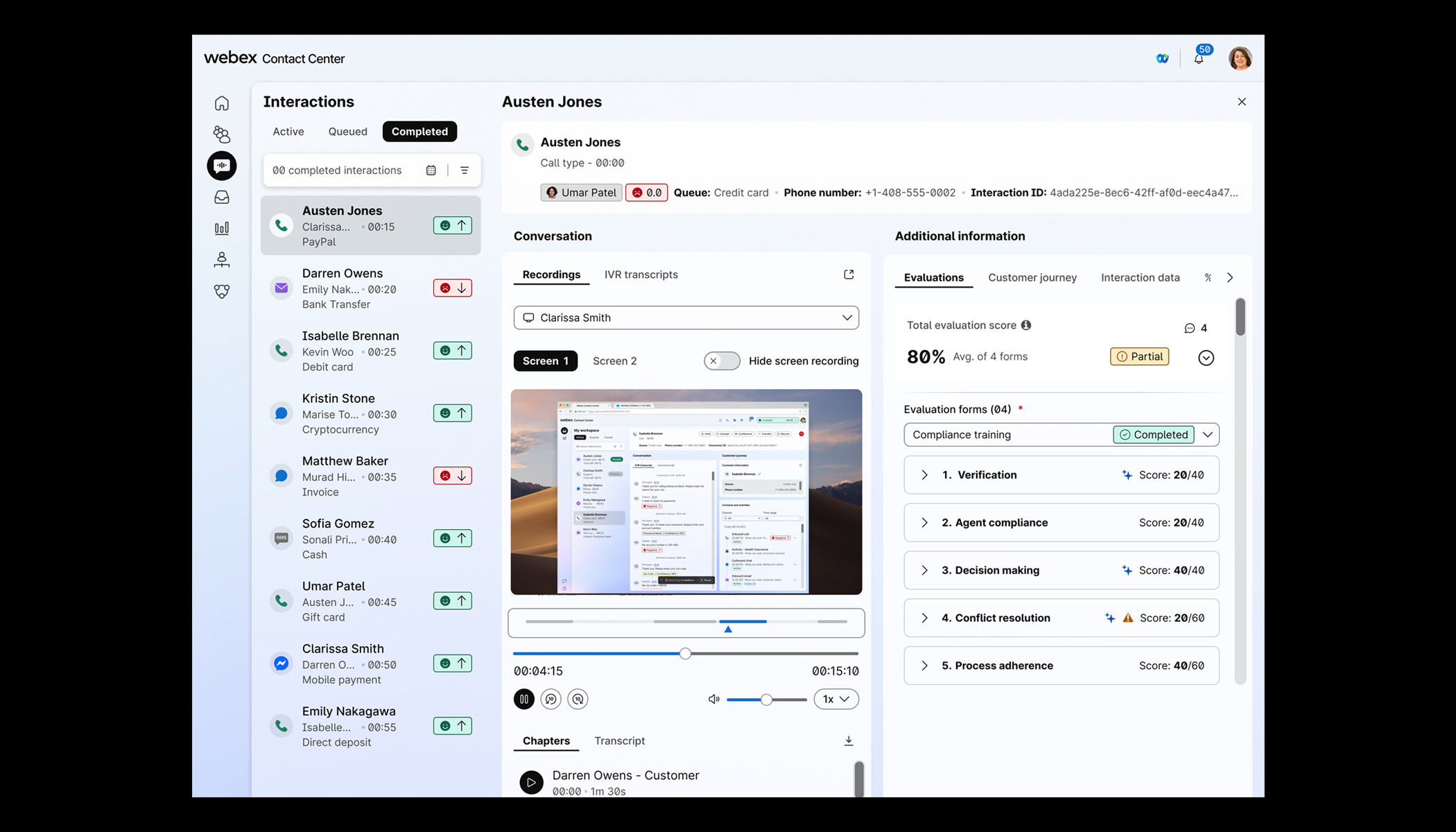
Coaching becomes specific and fair. When supervisors can see every interaction, coaching is built on complete data, not an unrepresentative sample. Agents receive individual, evidence-backed feedback tied to their actual performance patterns, not a generic report card based on a handful of reviewed calls.
Compliance becomes real. For organizations in regulated industries, 100 percent coverage transforms compliance from a sampling exercise into genuine governance. Every interaction is evaluated. Every gap is visible. Every risk is identifiable before it becomes a liability.
Supervisors reclaim their role. When AI handles the procedural evaluation layer automatically, supervisors redirect their time from manual audit to meaningful coaching.
Across the deployments we see, QM teams typically spend dozens of hours per week combined on manual review, scoring, spreadsheet maintenance, and dispute resolution. That time represents the single largest untapped coaching capacity in most contact centers today often translating to more than 11 hours per week per supervisor once AI absorbs the procedural workload. Shifting that time from audit to development is where the real transformation happens.
The data tells a complete story. When quality data, sentiment scores, speech analytics, and operational contact center metrics live in the same platform, the insights compound. The picture becomes complete. And the insights that emerge are not observations, they are outcomes. With features like “Metrics to Watch”, supervisors no longer have to hunt for outliers. The system automatically benchmarks individual performance against team averages, instantly surfacing who needs support and why. It turns a two-hour data deep-dive into a two-minute coaching preparation.
One of the less-discussed shifts happens in how agents relate to their evaluation data. In many contact centers today, agents do not see their scores directly, disputes happen over email or through a conversation with a supervisor, always after the fact. When agents can see their own AI-generated evaluations with clear justifications tied to specific transcript moments, the nature of the conversation changes entirely. Disputes drop because the evidence is visible. Coaching becomes collaborative because both sides are looking at the same data. Quality management moves from being done to agents to being done with them.
As one contact center operations leader recently told us: “We’re not just grading calls anymore. We’re building a better team.” That shift, from quality management as an audit function to quality management as a development engine is the real transformation these organizations are experiencing.
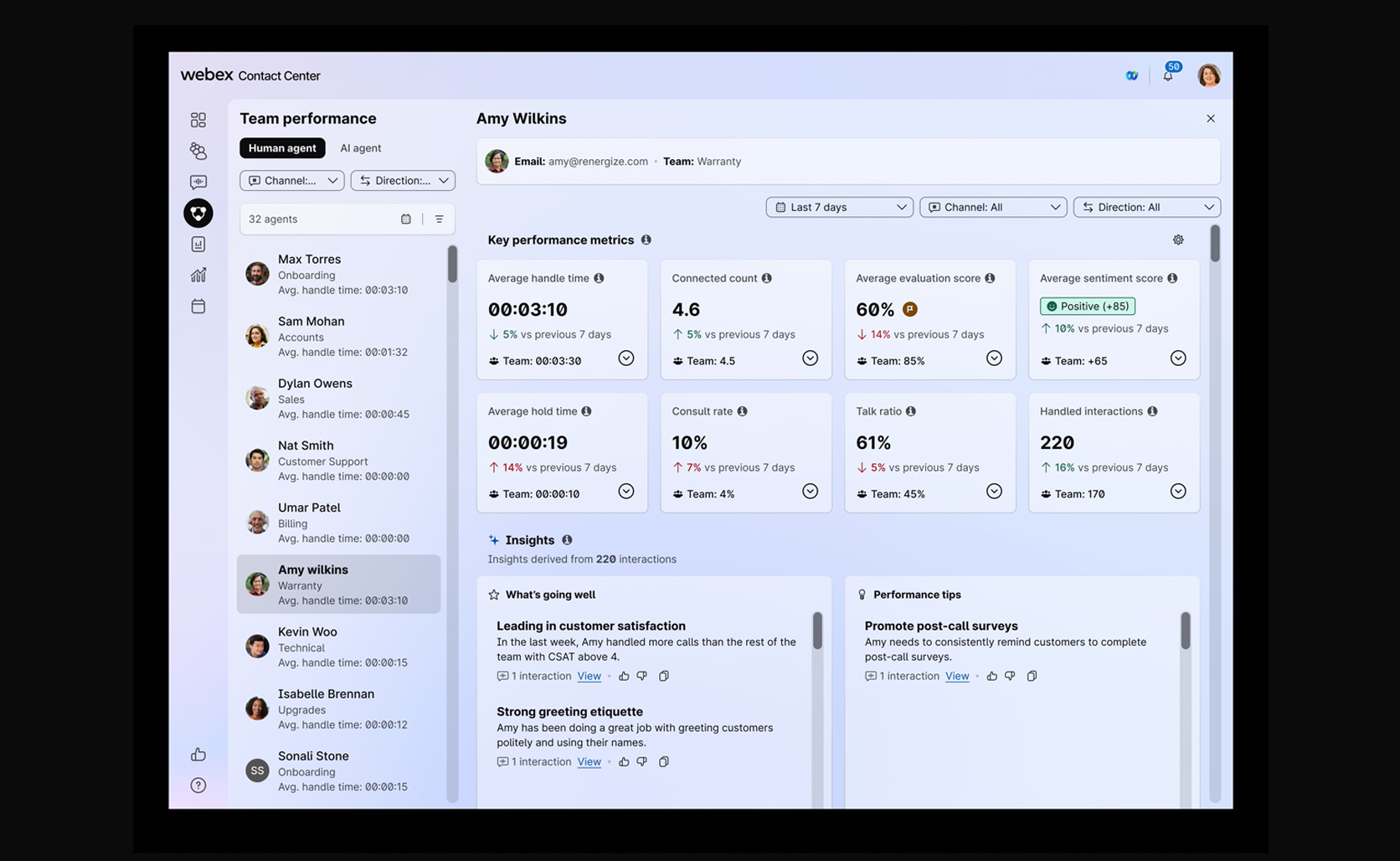
Supervisors gain a complete, unified view of agent performance across every interaction.
The Cisco Approach: A Quality Intelligence Suite
Webex AI Quality Management is built on the recognition that every contact center has its own definition of quality. Rather than applying a generic AI model across all customers, the solution keeps the human in the loop when a supervisor overrides an AI evaluation score, that correction becomes a training signal. The model retrains toward that organization’s specific standards, continuously narrowing the gap between AI judgment and human judgment.
Over time, it becomes the organization’s AI, calibrated to their processes, their compliance requirements, and their definition of what a great interaction looks like.
Here is the question: when an AI agent handles a customer conversation, who is evaluating the quality of that conversation?
In most contact centers today, the honest answer is nobody. Traditional QM tools were built for human agents. AI agents are operating outside any consistent quality governance framework. That gap is only going to widen as AI handles a larger share of interactions.
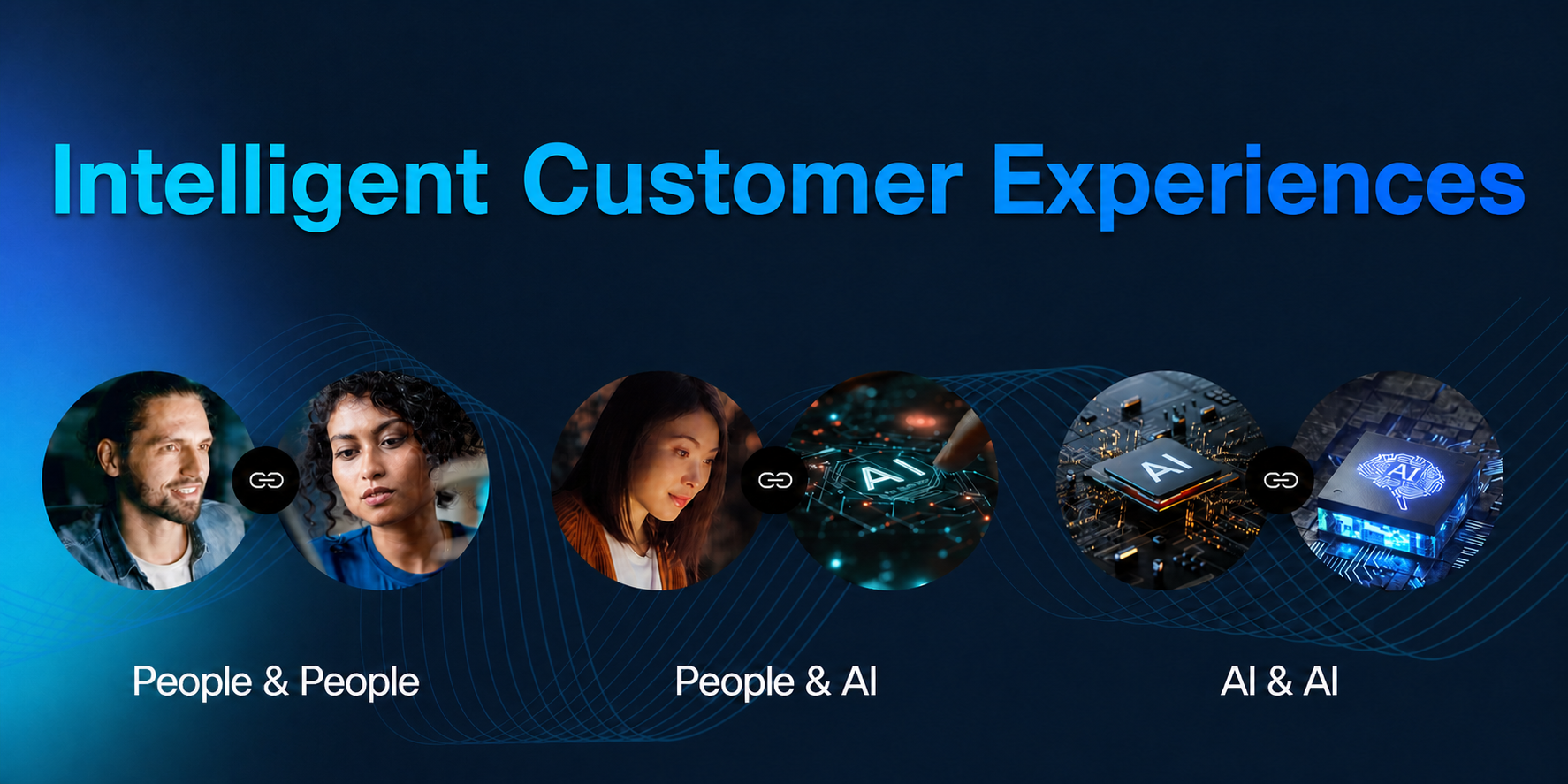
Webex AI Quality Management provides a unified evaluation framework that covers both human and AI agent interactions against the same quality standards. Customers do not experience “human quality” and “AI quality” as separate categories, they experience your brand. The quality framework has to reflect that reality.
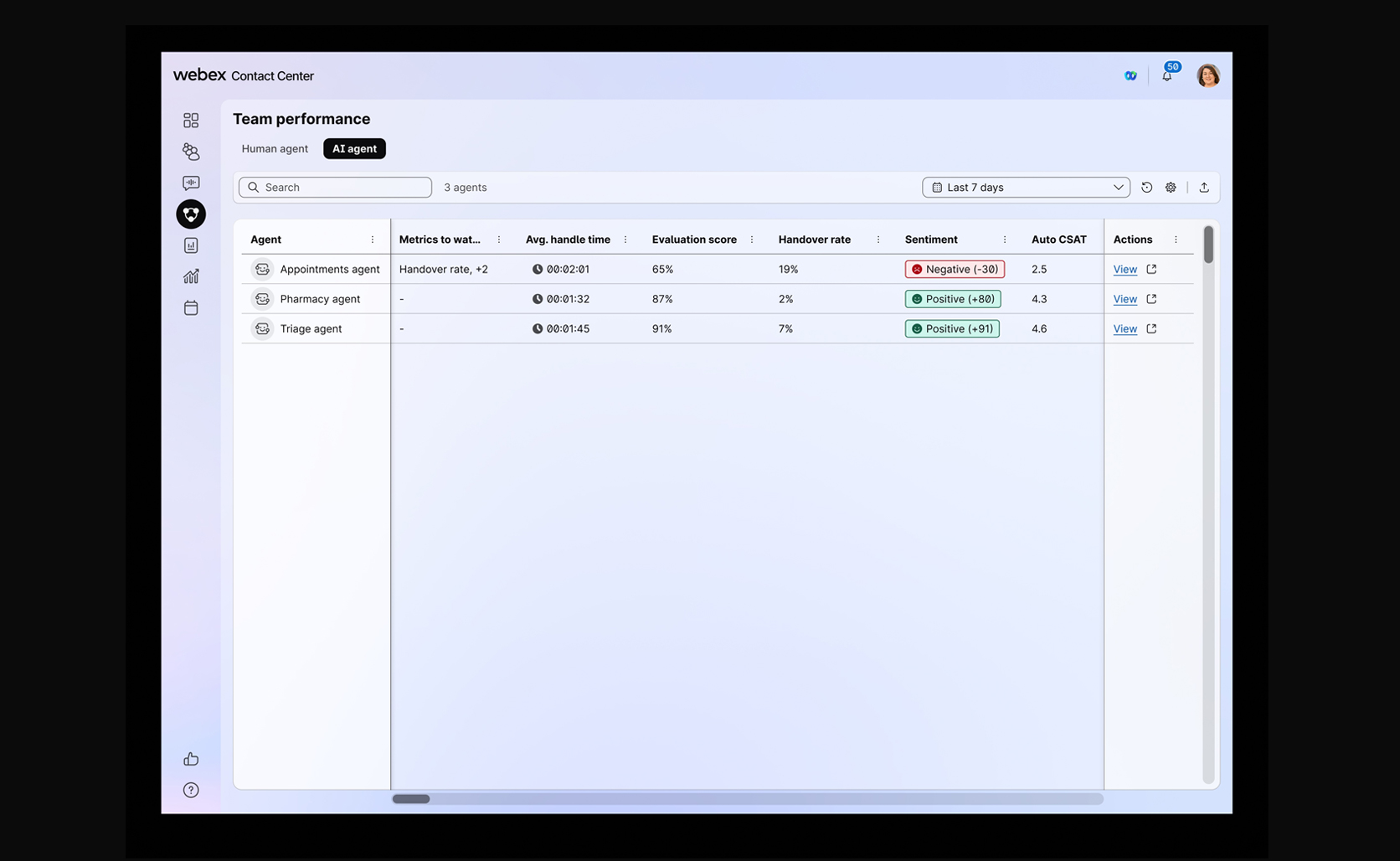
Supervisors gain a complete, unified view of human agent and AI agent performance across every interaction.
One of the most important aspects is that the quality intelligence now resides in a single unified interface with our contact center reporting through Webex Contact Center Analyzer. Customers can view their contact center operational metrics alongside quality metrics in the same reporting interface, no reconciliation, no switching between tools, no fragmented reporting. All of this data is accessible through our APIs, allowing organizations to move evaluation scores, sentiment data, and operational KPIs seamlessly into external BI tools such as Tableau or Power BI. This breaks the silo that has historically forced quality data to live apart from the rest of the business, allowing it to sit alongside financial and operational KPIs for a true 360-degree view of performance.
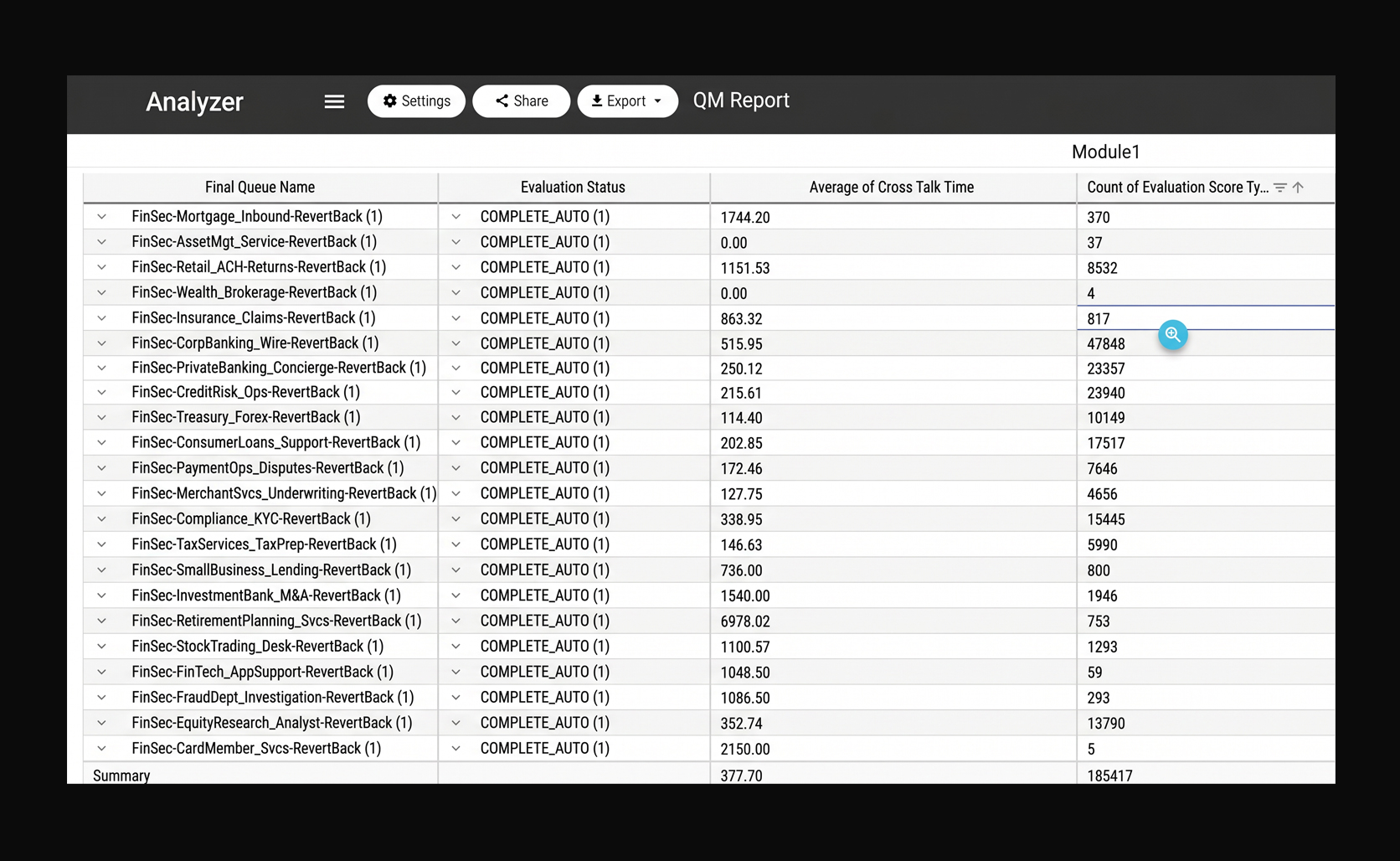
Quality data and operational metrics unified in a single reporting environment.
Built on Responsible AI
Every AI evaluation score in Webex AI Quality Management comes with a transparent justification, a written explanation tied directly to the specific moment in the transcript that informed the score. Supervisors can review the reasoning, override the score, and in doing so, actively improve the model’s accuracy over time. When enough corrections accumulate, the system automatically retrains, no manual intervention required.
Every trained model is specific to one organization. The training data used to build it never leaves the Webex Contact Center cloud and is never shared with any other organization.
This transparency is not a feature layer added on top of the solution. It is how the solution is architected, governed by Cisco’s Responsible AI Framework across six principles: Transparency, Fairness, Accountability, Privacy, Security, and Reliability. Full technical details are available in the Webex AI QM Transparency Note for customers and their compliance teams.
The Future of Contact Center Quality
The customer experience leaders we work with are not asking how to check more compliance boxes. They are asking how to understand what is actually happening in every customer conversation and how to act on what they find.
That requires a quality intelligence suite, not a quality management tool.
It requires coverage of every interaction, not a sample.
It requires AI that learns each organization’s specific standards, not a generic model.
It requires quality data that works with the rest of the contact center intelligence, not in a silo beside it.
Turning the lights on is only the first moment. What matters is what you do when you can finally see the whole room, the patterns, the gaps, and the opportunities that have been there all along, just invisible.
The future of quality management is not about scoring more calls. It is about finally seeing all of them and knowing exactly what to do with what you find.
The contact centers that build this intelligence layer now will have a quality infrastructure ready for the hybrid workforce of 2026. The ones that wait will be building it under pressure when their first AI agent compliance event surfaces.
See what 100 percent visibility looks like for your contact center. Connect with the Webex team to explore Webex AI Quality Management.
Resources
About The Author