This week, we welcomed thousands of attendees to Cisco Live Las Vegas 2026, bringing together hundreds of technical and business sessions, keynotes, and live demos. It was an exciting opportunity to connect with customers and partners and showcase the latest innovations shaping the future of collaboration. I was especially excited to share the latest advancements in Cisco Calling, including our latest AI-powered innovations, new Webex Calling announcements, and expanded options for hybrid deployments.
New Heights for Webex Calling

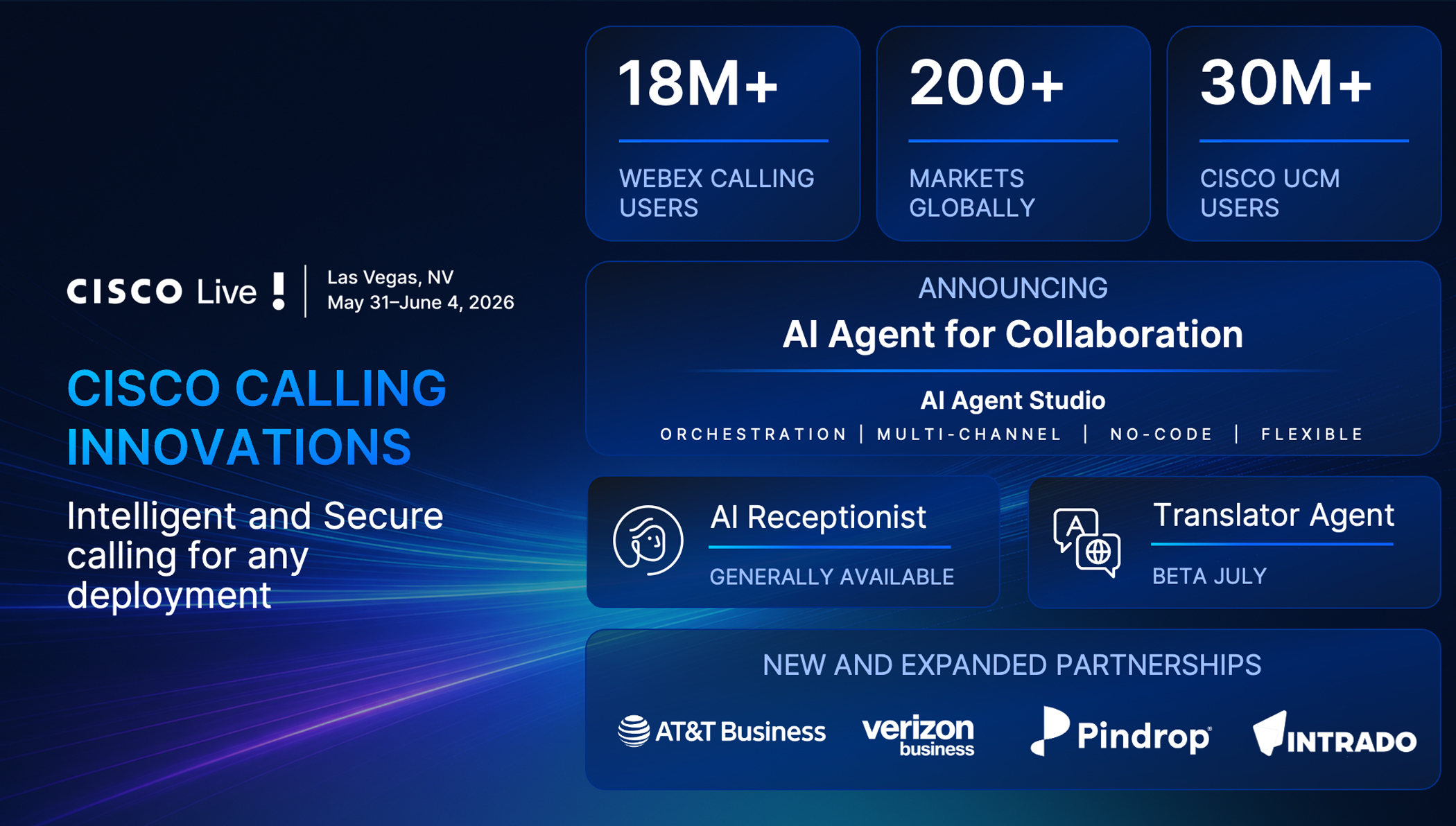
Webex Calling continues to reach new milestones. Today, we support over 18 million users across more than 200 markets worldwide. Our customers include mission-critical organizations that rely on Webex for secure, reliable communication at scale, including Brink’s, Inc., HD Supply, Sutherland Global, and thousands more.
AI-Powered Calling Journey
Our customers rely on Webex Calling to deliver AI innovation that makes communication smarter, faster, and more productive. At Cisco Live, we were excited to share the latest innovations that help customers get even more value from every call.
AI Receptionist for Webex Calling
With AI Receptionist for Webex Calling, now generally available, organizations can deploy a virtual front desk that answers calls 24/7, responds to common questions, and handles tasks like call routing, lead capture, and appointment scheduling. By automating routine interactions, teams can spend more time on high-value conversations that drive better outcomes.
AI Agents for Collaboration: Custom Agents for Any Workflow
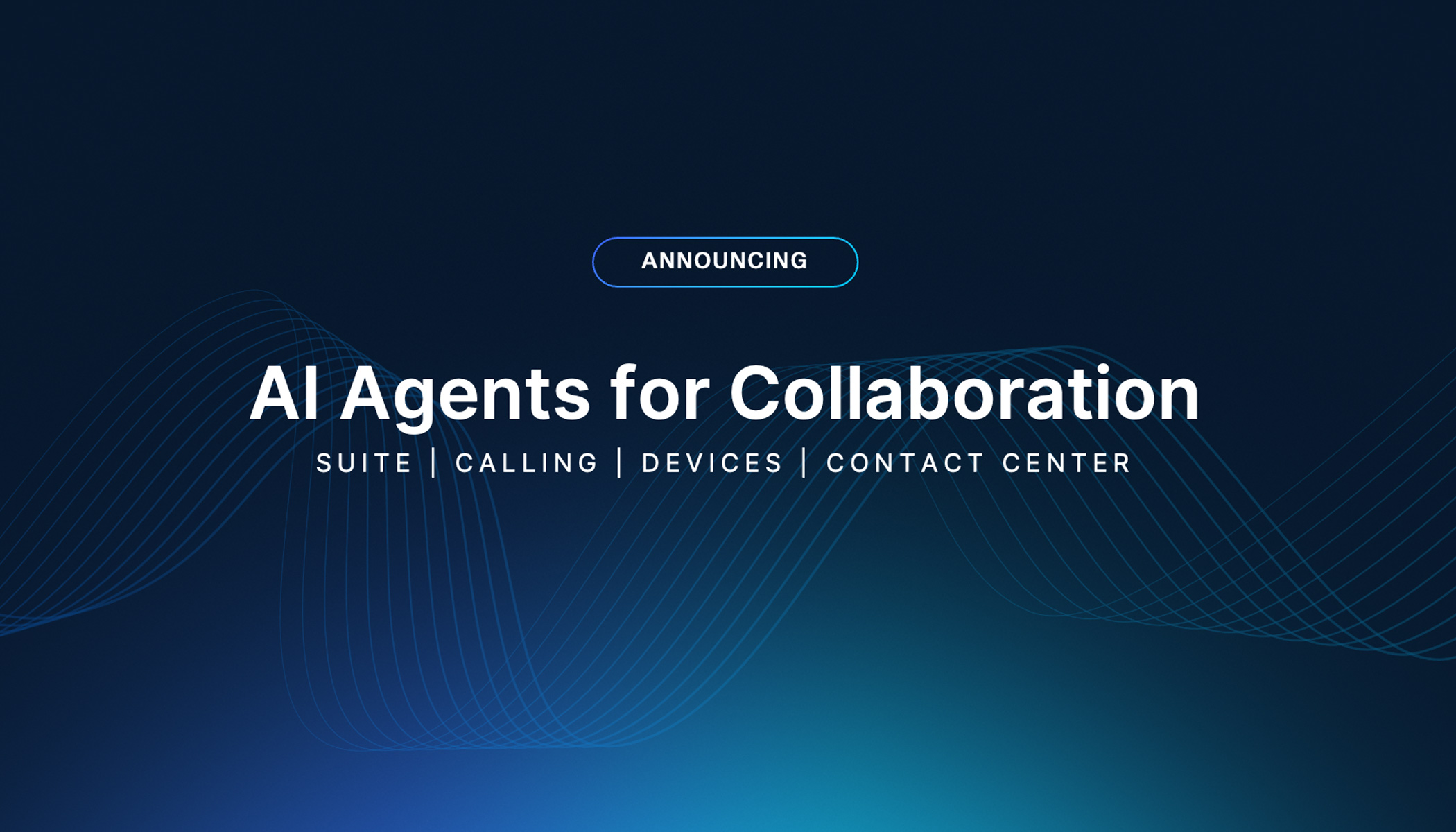
At Cisco Live 2026, we introduced AI Agents for Collaboration, a major step forward in how AI can help transform everyday work. These custom, multimodal agents bring the orchestration technology behind Webex Contact Center to more businesses, teams, and users, helping them automate workflows across voice, video, and digital interactions.
Built and configured in AI Agent Studio, AI Agents for Collaboration use a simple, conversational experience that makes it easy for businesses, teams, and even individual users to create agents tailored to how they work. Customizable for virtually any use case, these agents can understand intent, collect information, connect to business systems, apply business-specific logic, and automate multi-step processes from start to finish.
They also complement pre-built agents like AI Receptionist. While AI Receptionist helps businesses quickly answer calls, route callers, and respond to routine inquiries, custom agents extend automation into workflows unique to each organization, helping turn conversations into completed work.
AI Agents for Collaboration will be available in the second half of calendar 2026.
Cisco AI Assistant for Webex Calling
Earlier this year, we launched AI Assistant for Webex Calling, extending intelligence across every conversation. AI Assistant helps teams understand context before the call begins, stay focused during the interaction, and follow through afterward, with capabilities including:
- Ask AI Assistant: Stay prepared and informed. Ask questions in your own words to prepare for calls, catch up on messages and action items, or search across workloads with Copilot, Glean, and Amazon Q integrations.
- Microsoft Copilot Integration: AI Assistant can access information directly from your Microsoft files, like SharePoint, OneDrive, and Copilot, to give you much more detailed and helpful answers.
- Live call summaries: automatically capture notes, summaries, and action items during the call.
- Shared summaries: make transfers seamless by sharing context so the next person is informed before they answer.
- Post-call summaries: Eliminate notetaking with key details and call summaries available in your Webex app call history.
- Workflow automation: Use Webex Suite productivity agents such as Meeting Scheduler, Jira and Salesforce to complete actions in these systems without leaving the Webex app.
- Caller intent (Coming soon in July): View a summary of the caller’s likely reason for calling, based on prior interactions.
AI Assistant for Webex Calling is now generally available to customers worldwide.
Translator Agent
I’m also excited to announce that Translator Agent for Webex Calling will be available in beta in July. Translator Agent delivers real-time speech-to-speech translation, enabling employees to communicate seamlessly with colleagues and customers across languages. This expands global collaboration and reduces the need for language-specific staffing, allowing organizations to support a broader customer base with their existing, highly trained teams.
AI-Powered Customer Assistance for the Front Line
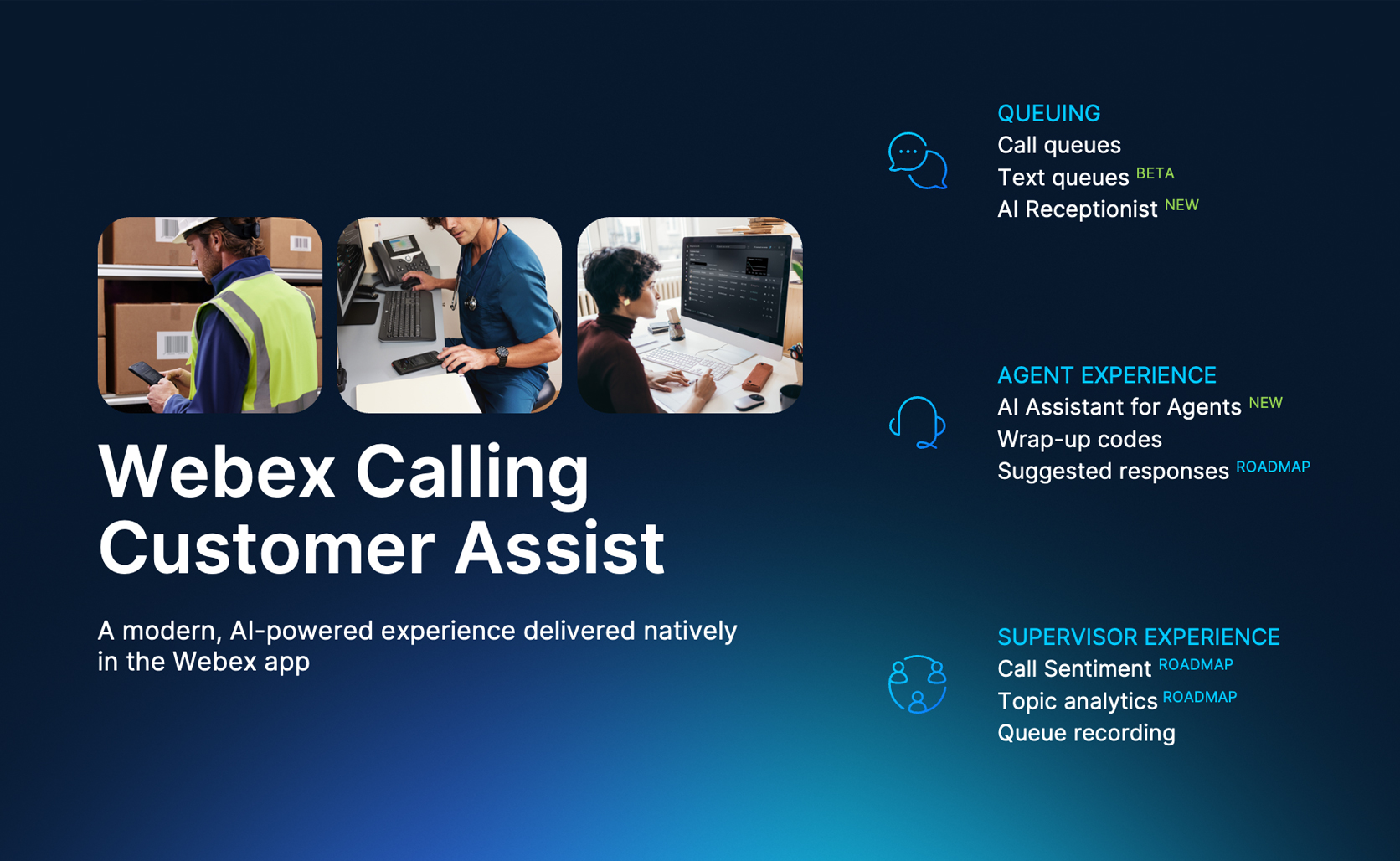
Our AI innovations complement Webex Calling Customer Assist, designed for high-volume environments like branches, retail stores, clinics, and local offices where a full contact center may not be the right fit. Customer Assist brings agent and supervisor tools directly into the Webex app, helping teams manage interactions with more speed, consistency, and visibility.
We continue to enhance Customer Assist with capabilities like text queues, giving businesses a convenient digital channel to serve customers faster. Later this year, we will also launch new AI capabilities, including Suggested Responses, Call Sentiment, and Topic Analytics. These capabilities will be available through our Premium AI license, generally available in Q3 CY2026.
Delivering Calling to Organizations Worldwide
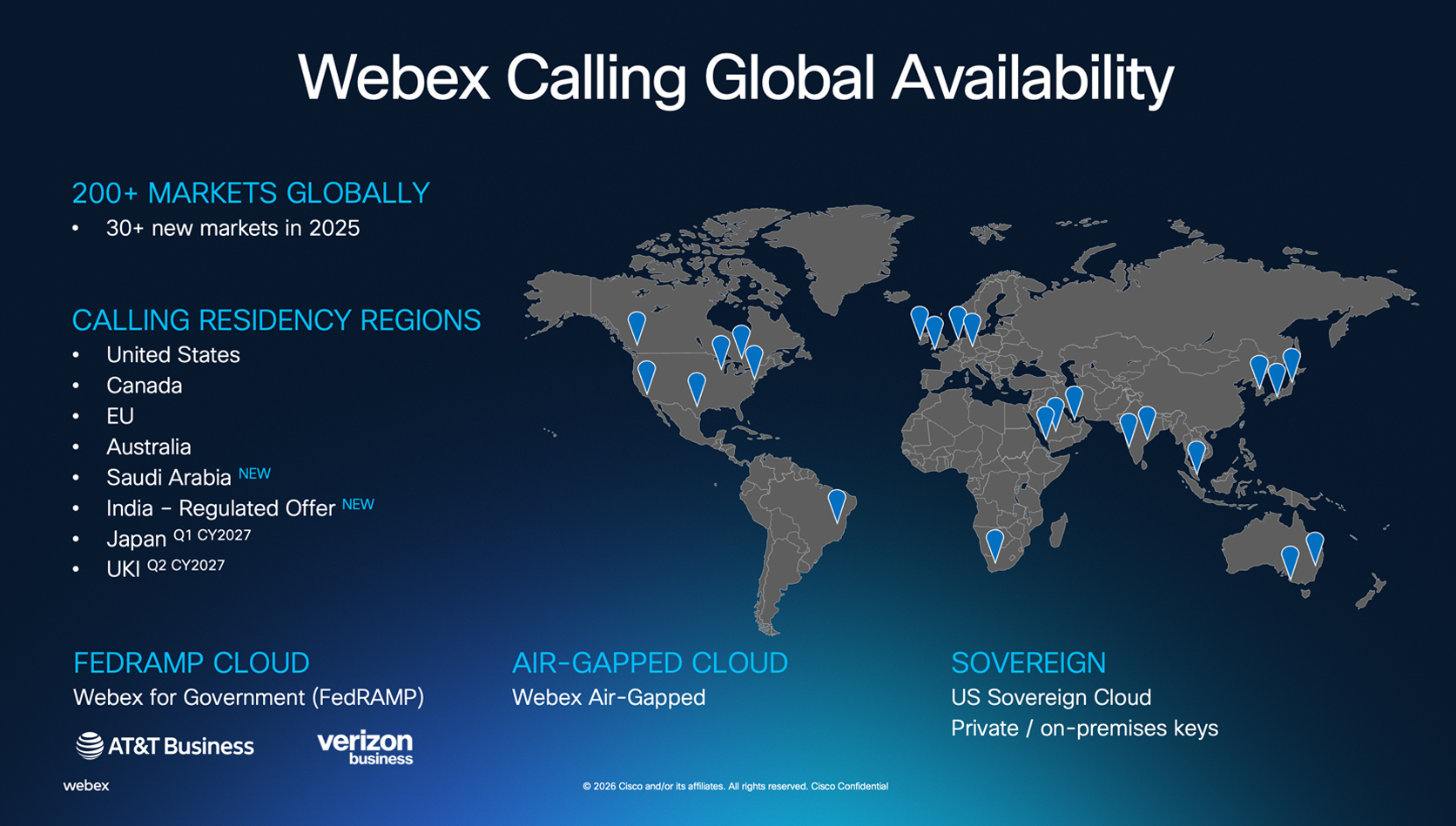
We deliver enterprise calling and AI innovations to a global customer base, including mission-critical and highly regulated organizations where visibility and control over data are paramount.
For customers that require strict control over where their data resides, we continue to expand our global footprint. Webex Calling will soon support calling data residency in Japan and the United Kingdom, adding to existing residency available in the United States, Canada, the European Union, Australia, Saudi Arabia, and India. This gives organizations greater flexibility to meet regional data requirements while maintaining a consistent global experience.
We also continue to enhance our FedRAMP offer to better serve U.S. federal agencies and organizations that work with them. Through new partnerships with AT&T and Verizon, we now provide cloud PSTN options that assist customers with deploying secure, compliant calling solutions
Secure and Resilient Calling for Mission-Critical Organizations
Webex Calling offers a 99.999% SLA and site survivability, further strengthening resilience. This helps ensure that an essential set of calling capabilities remains available even if connectivity to the cloud is disrupted. For mission-critical environments, this provides the assurance that communication can continue without interruption, regardless of network conditions.
Security continues to be a top priority across all deployments. Through our partnership with Pindrop, we are introducing enhanced detection against deepfake and synthetic voice attacks. As AI-generated audio becomes more sophisticated, organizations face new risks in voice-based fraud and impersonation. This capability helps detect and mitigate those threats, adding a critical layer of trust to every call.
We’re also extending our E911 capabilities through a partnership with Intrado as a SolutionsPlus partner, complementing the robust emergency calling solutions already available in Webex Calling. This gives customers greater deployment flexibility, especially for organizations that have already standardized on Intrado, while continuing to deliver accurate emergency call routing and location support for today’s distributed workforce.
Future-Proof Flexibility
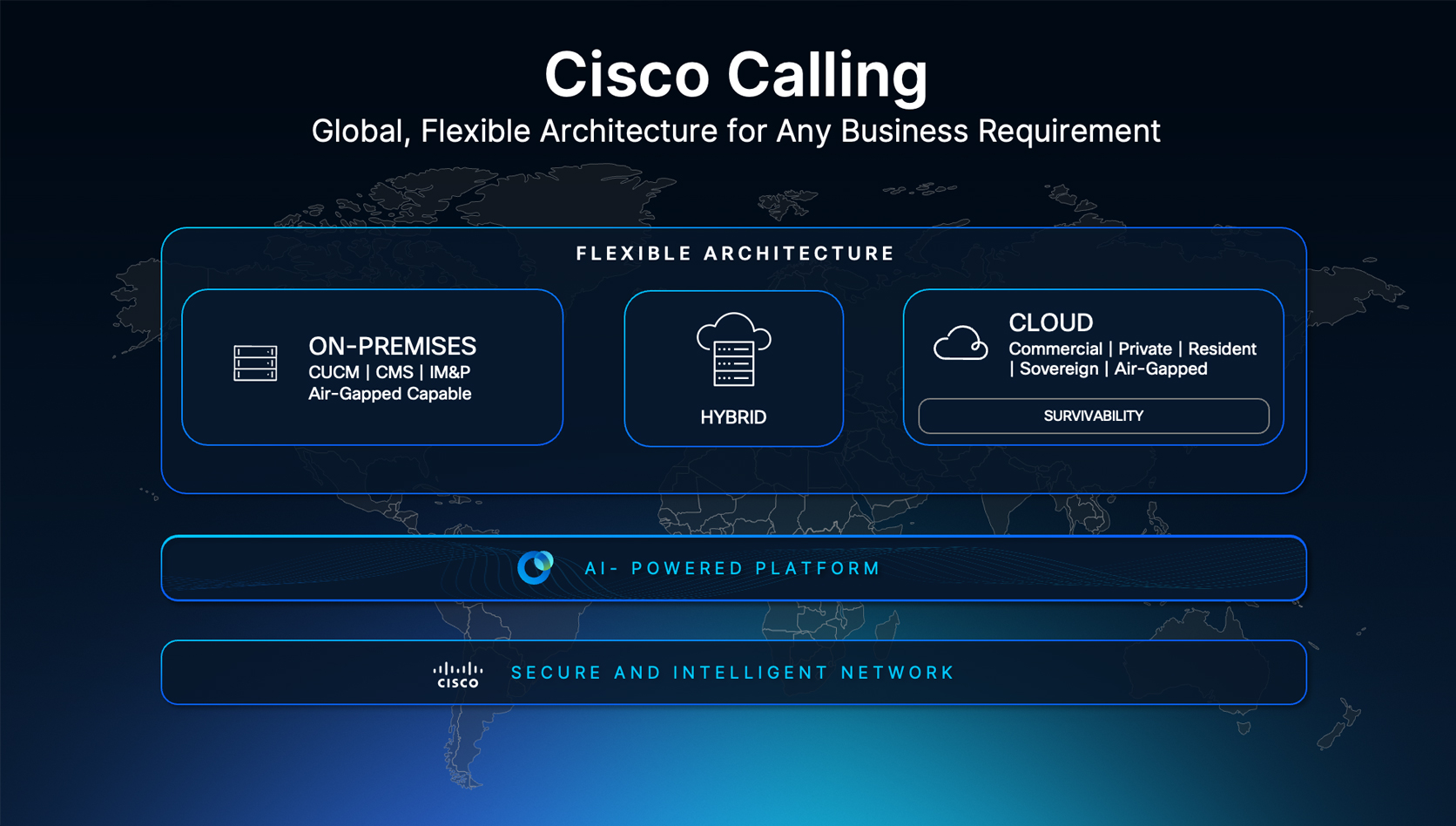
For nearly three decades, Cisco has been a leader in enterprise calling, powering mission-critical communications for organizations around the world. Today, Cisco supports customers across both on-premises and cloud deployments, with Cisco Unified Communications Manager serving more than 30 million users worldwide, including organizations in government, defense, critical infrastructure, retail, manufacturing, healthcare, and financial services.
Many of these organizations operate in demanding environments that come with unique requirements. A full move to the cloud is not always feasible due to regulatory constraints, security considerations, or the risk of business disruption. These are environments where reliability, control, and compliance are non-negotiable.
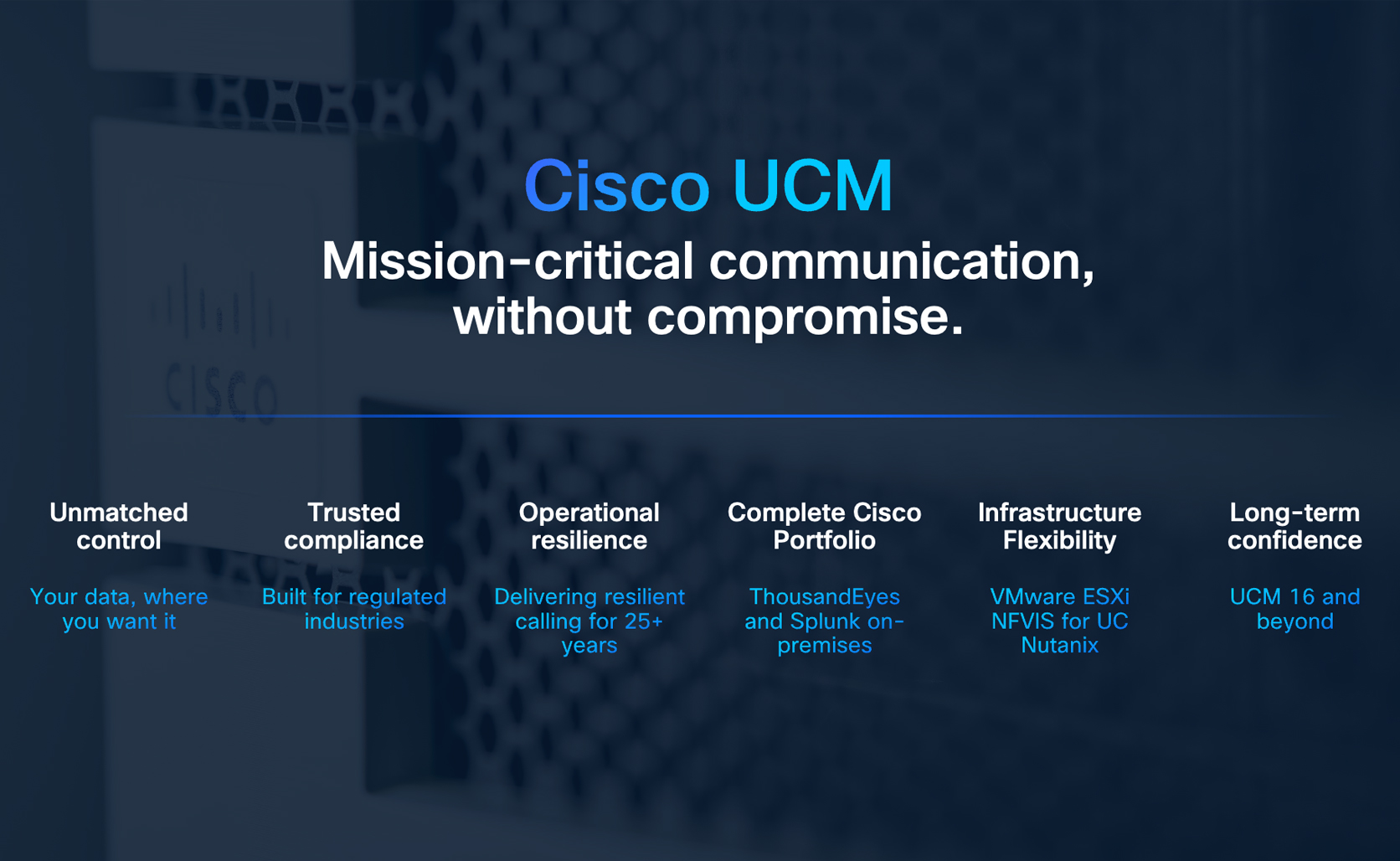
Our commitment to these organizations drives our continued investment in Cisco UCM. Since the launch of version 15, we have delivered four service updates, administrative and user experience enhancements, hundreds of security updates, and new certifications. We are also excited to announce that version 16 is planned for calendar year 2027.
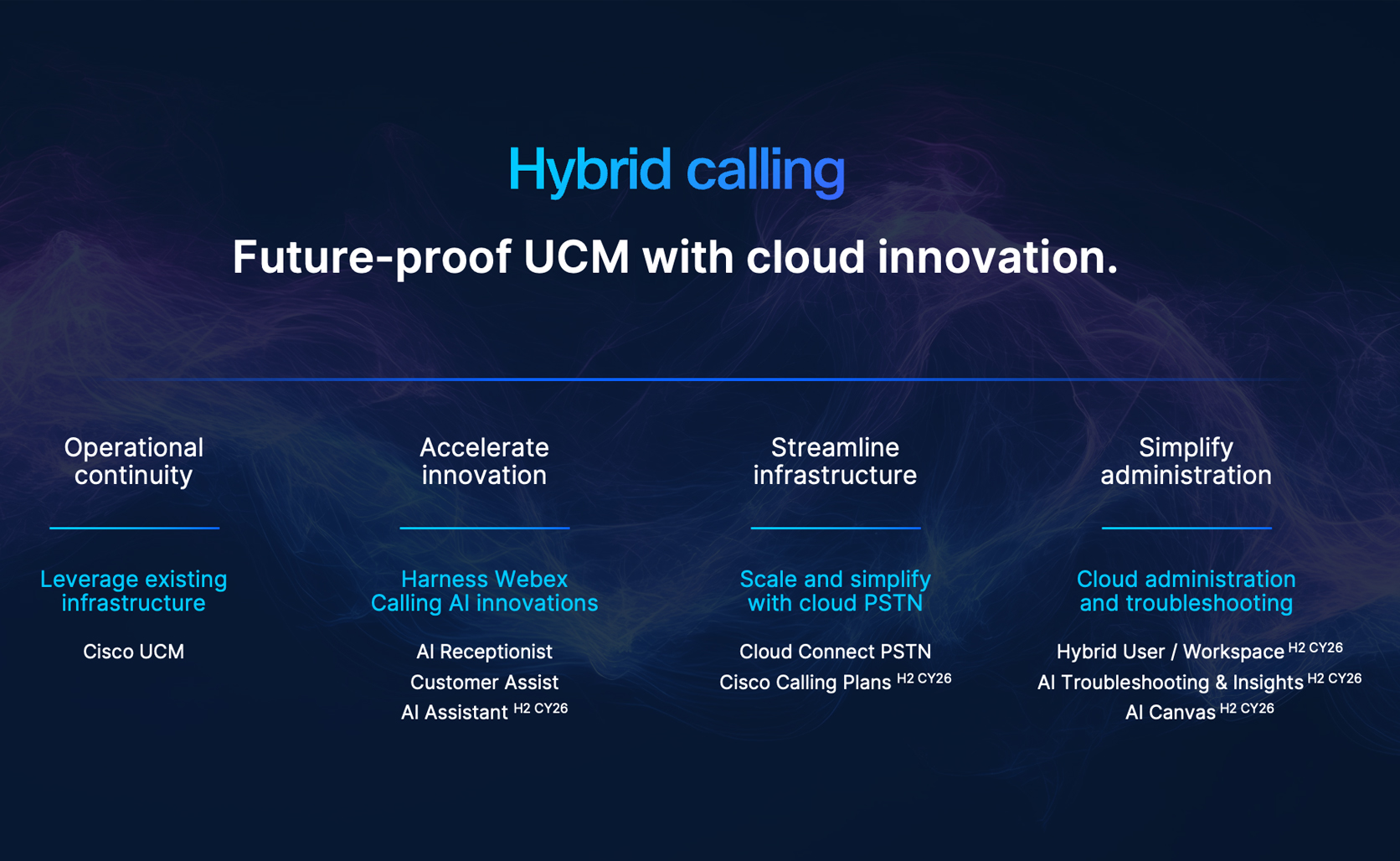
At the same time, we recognize that customers still want access to cloud innovation. Historically, staying on-premises meant missing out on capabilities like AI, centralized administration, and flexible cloud infrastructure.
We are addressing this with Webex Calling Hybrid. This approach allows Cisco UCM customers to adopt cloud services where it makes the most sense, while aligning with their security, compliance, and regulatory requirements.
This model is already delivering new capabilities. We have introduced Customer Assist for UCM and will soon bring AI Receptionist for UCM, along with continued enhancements to cloud-based administration. Additional innovations, including AI Assistant for UCM and Cisco Calling Plans for UCM, will be launched later this year.
Bringing Collaboration into One Cisco Experience
Managing collaboration effectively requires more than visibility into calling alone. Voice and video quality depend on the full environment, from network performance and policies to endpoints and user experience. To address this, Cisco is bringing Collaboration Control Hub into Cisco Cloud Control, creating a more unified way to manage collaboration alongside the broader Cisco portfolio. With Cisco Cloud Control, IT teams gain a single destination for visibility across collaboration, networking, security, and observability.
Cisco is also extending this experience with AI Canvas, accessible through Cisco Cloud Control. AI Canvas lets administrators ask questions in natural language and receive answers drawn from Control Hub and other Cisco platforms, helping teams quickly understand what is happening, why it is happening, and what to do next.
This becomes especially powerful for call quality troubleshooting. AI Canvas can correlate collaboration data with ThousandEyes and Meraki data, identify likely root causes, and recommend corrective actions, such as updating a Meraki QoS policy to prioritize real-time media traffic.
Together, Cisco Cloud Control and AI Canvas show the value of the Cisco portfolio working as one system: broader visibility, simpler troubleshooting, and faster resolution to help keep calls reliable, clear, and consistent. This integrated experience is now available in Controlled Availability.
Built Together with Our Cisco Calling Partners
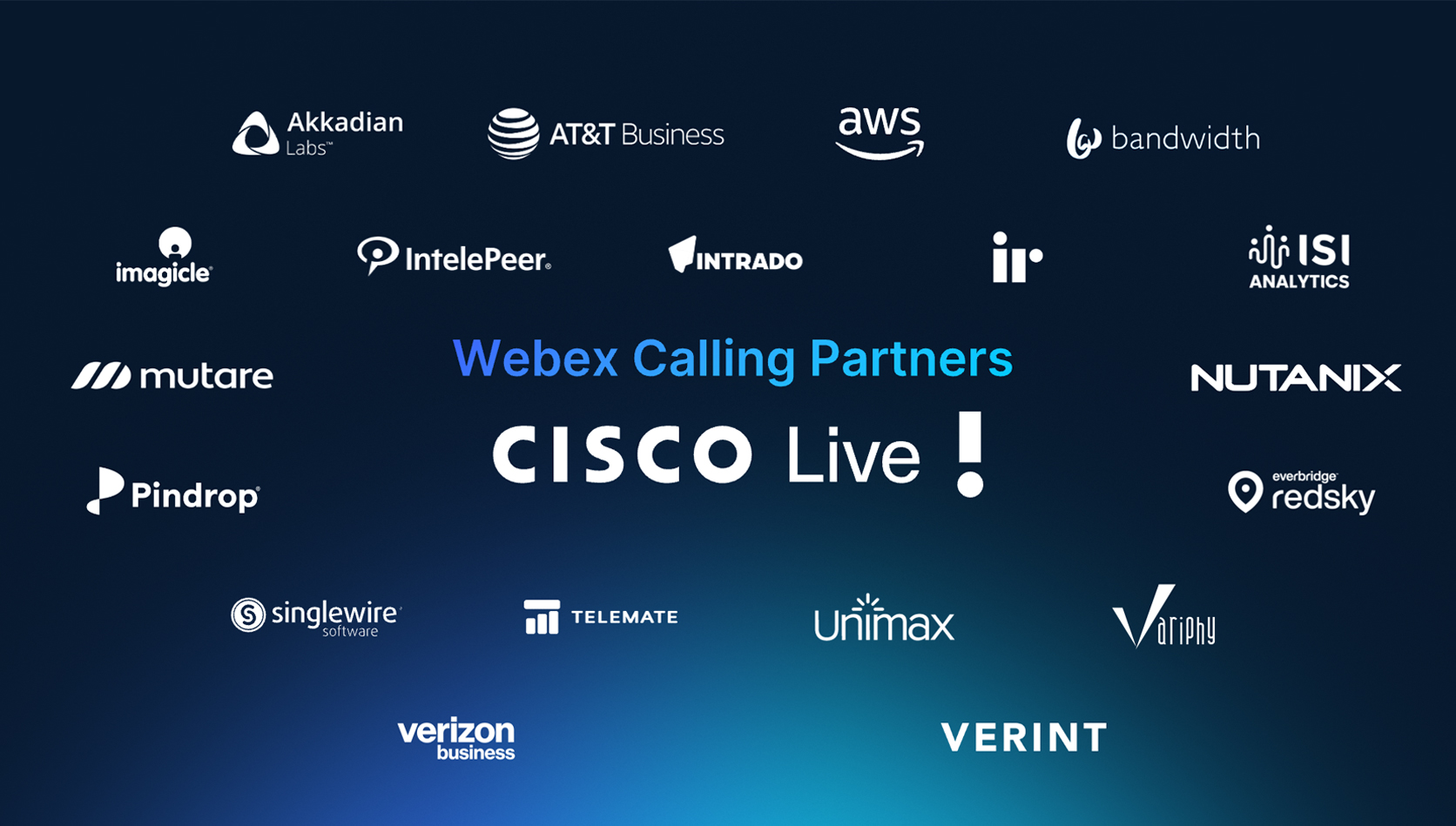
Cisco Calling is stronger because of the partner ecosystem that surrounds it. Delivering a complete cloud calling experience takes a broad community of carriers, software providers, hardware partners, analytics specialists, and emergency services leaders working together to support customer success. The partners featured at Cisco Live reflect the scale and strength of that ecosystem and the many ways Webex Calling is extended to meet real customer needs, including PSTN connectivity, E911 support, compliance recording, analytics, insights, and overall user experience.
Advancing the Future of Calling
Thank you to our customers and partners who joined us at Cisco Live and shared their experiences, feedback, and ideas. Your stories continue to shape how we innovate across Webex Calling and the broader collaboration portfolio. And we are just getting started. There is much more ahead as we continue bringing intelligence, security, and simplicity to every call. Join us at WebexOne 2026 to see what is next.
Learn more:
Transform enterprise communication with Webex Calling AI ebook
About The Author