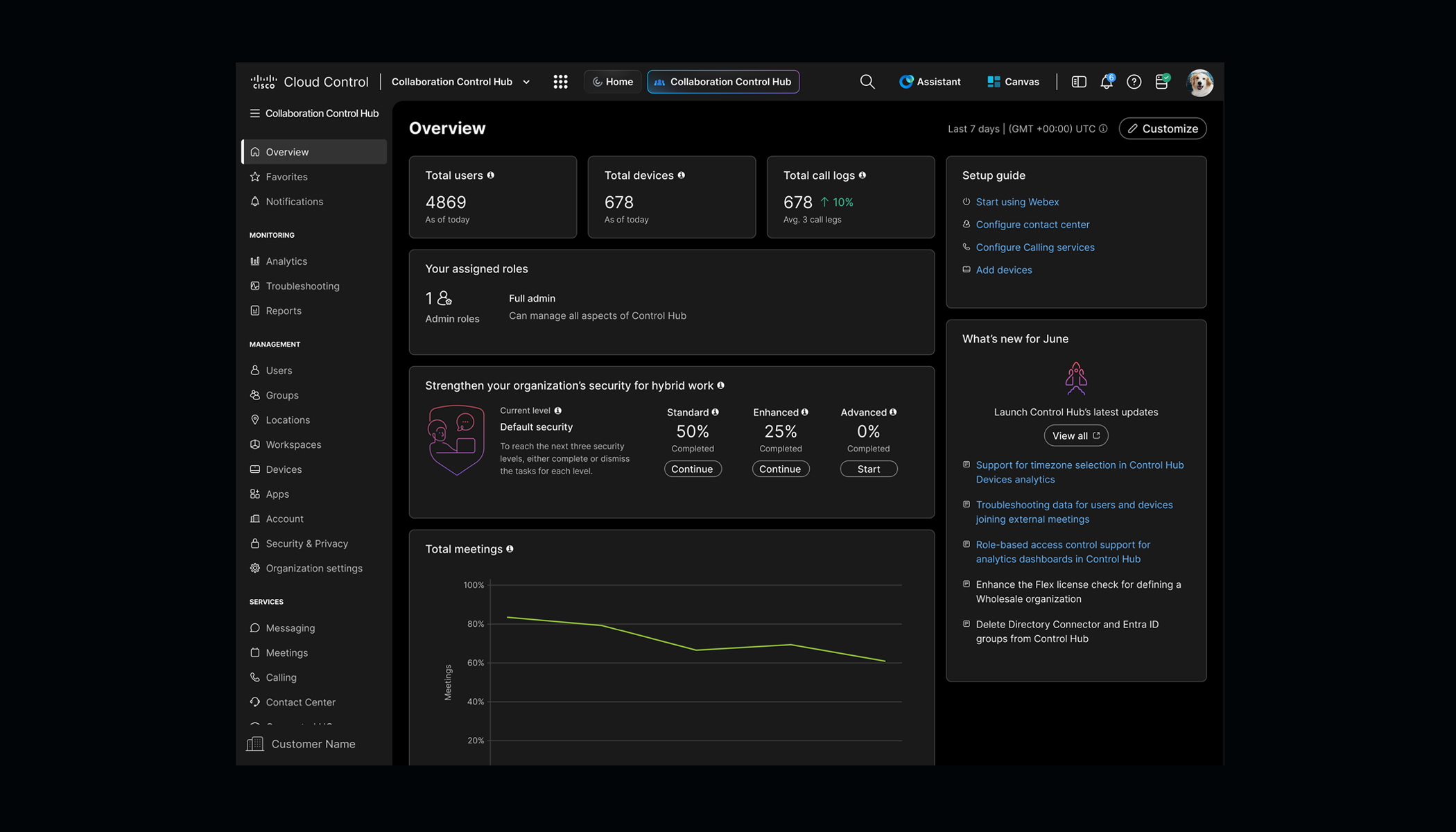
Collaboration Control Hub gives IT teams a powerful single pane of glass to manage users, devices, workspaces, calling, meetings, messaging, compliance, and more. As collaboration environments expand, however, administrators must navigate an increasing volume of settings, documentation, reports, telemetry, and operational data.
AI is making that information easier to use. By helping administrators search by intent, ask questions in context, explore reports, diagnose workspaces, and investigate issues across technology domains, Control Hub is reducing the effort required to move from question to insight and from issue to action.
Cisco AI Assistant in Control Hub
Administrators often spend valuable time locating information, interpreting data, and moving between tools before they can complete a task or resolve an issue. Cisco AI Assistant brings natural-language intelligence into Control Hub to simplify those everyday workflows.
Admins can ask questions, find configuration guidance, explore report data, and access workspace and device insights through a conversational experience. Instead of manually piecing together information, they can interact with Control Hub more naturally and reach the answers they need faster.
AI-Powered Search and Contextual Q&A
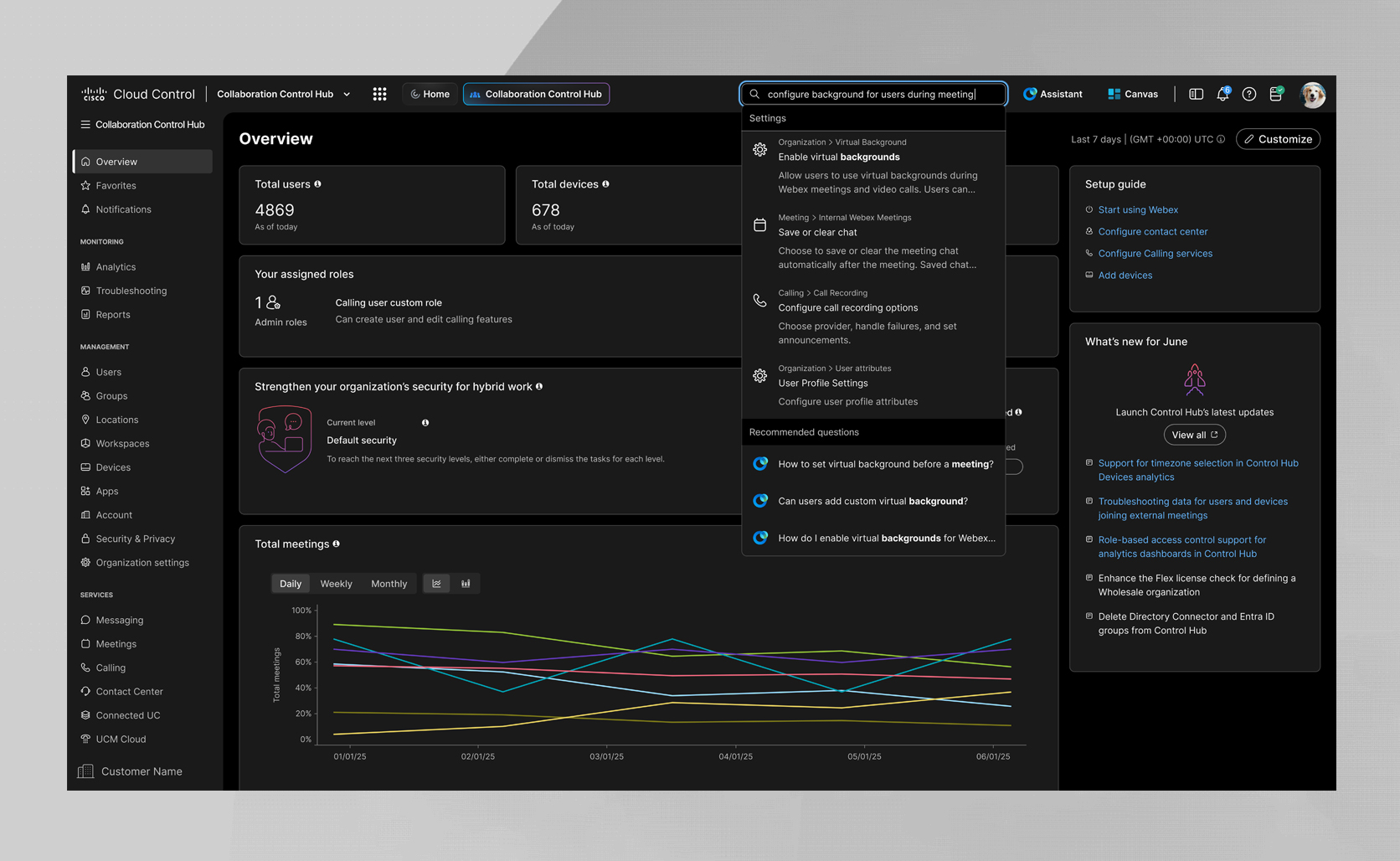
Administrators may know what they want to accomplish without knowing the exact feature name, menu path, or Cisco terminology associated with the task. Even a straightforward change can require searching documentation or navigating several layers of settings.
AI-powered smart search lets admins describe their intended outcome in natural language. Results continuously update as they type and refine their query, helping them quickly find relevant guidance and the right place to begin.
Contextual Q&A with recall provides additional support within the workflow. Admins can ask questions while configuring a service, reviewing information, or investigating an issue. AI Assistant retains context from earlier questions, enabling natural follow-up conversations without requiring users to repeat details or restart their search.
Together, these capabilities replace menu hunting and isolated searches with a more intuitive, outcome-oriented experience. New administrators can become productive sooner, while experienced teams can complete unfamiliar or time-sensitive tasks more efficiently.
Get Insights from Reports and Workspaces Faster
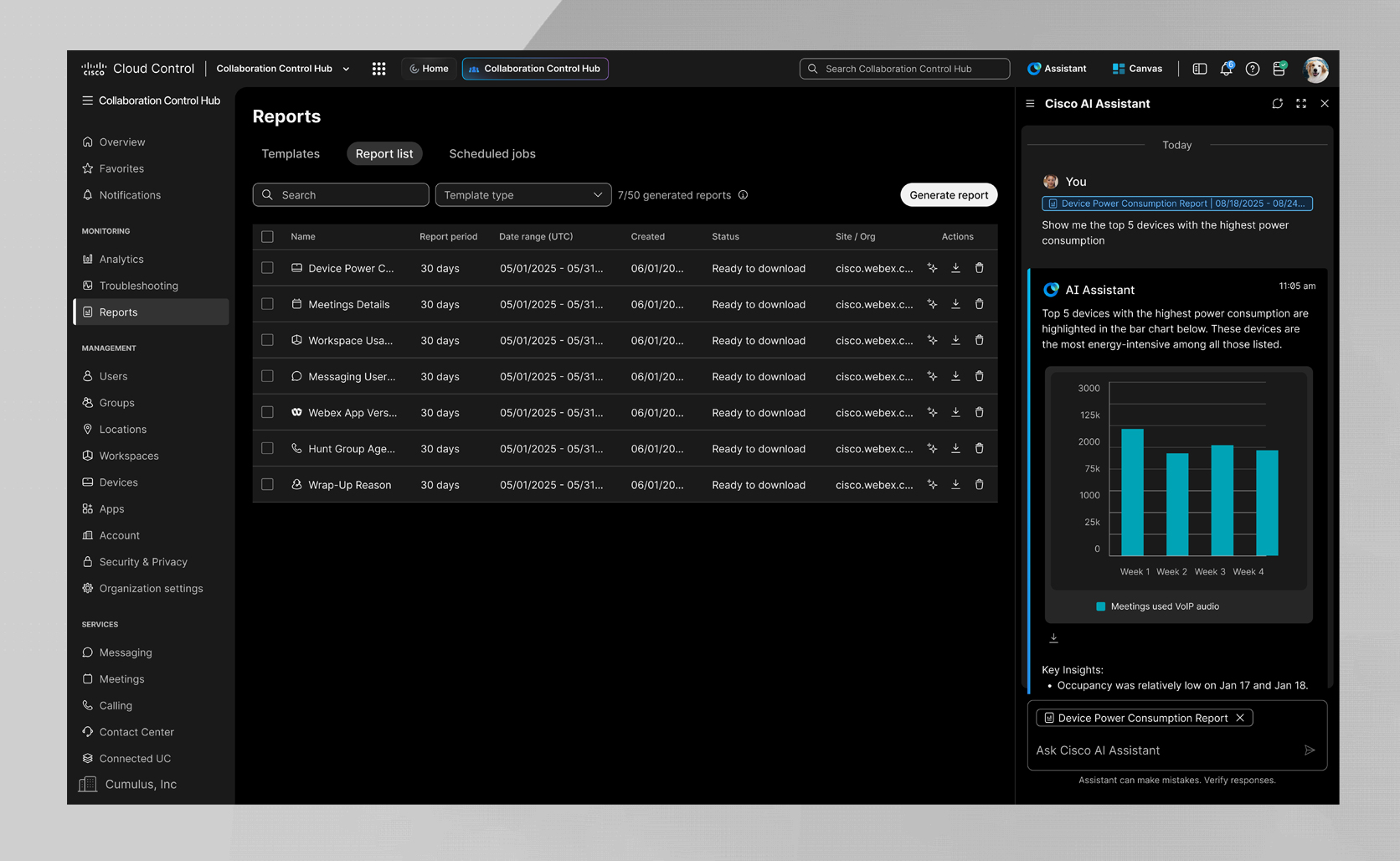
Control Hub provides comprehensive and customizable reports across Webex services, Cisco devices, and shared workspaces. But detailed reports and device telemetry can take time to interpret, especially when an administrator only needs a quick answer, trend, or insight.
Admins can ask questions about report data using natural language, either from within a specific report or through AI Assistant. AI Assistant reviews the data, provides a direct answer, and shows how the report supports its response. This helps teams monitor KPIs, track adoption, investigate quality trends, and identify areas that need attention without manually exporting, filtering, or manipulating data.
Admins can also ask natural-language questions about rooms, devices, and workspaces. Workspace diagnostics uses device telemetry, including status, usage, performance, configuration, and diagnostic data, to surface relevant answers and insights.
Together, these capabilities make operational information easier to understand and act on. Administrators can move from data to insight faster, identify potential issues, and support more reliable collaboration experiences.
Evolution to AgenticOps with AI Canvas
Many collaboration issues extend beyond the collaboration platform itself. A poor calling or meeting experience may originate from a device, endpoint, network path, or policy. Finding the root cause can require teams to switch between management systems and manually correlate information from multiple technology domains.
AI Canvas provides a shared, agentic workspace for investigating complex issues through natural-language interaction. It brings together context from Control Hub and other Cisco platforms so administrators can examine connected signals, understand likely causes, and evaluate recommended next steps in one place.
For example, AI Canvas can correlate collaboration data with insights from ThousandEyes and Meraki to identify where performance is degrading. It can then recommend an action, such as adjusting a quality-of-service policy to prioritize real-time media traffic. This helps teams move from a reported symptom to a root cause and potential resolution with less manual investigation.
AI Canvas represents a broader shift toward AgenticOps, where AI progressively takes on more repetitive, complex, and multistep operational work. As these capabilities evolve, administrators will be able to spend less time gathering information and coordinating routine actions, and more time improving services, planning strategically, and delivering better experiences.
A More Intelligent Approach to Collaboration Operations
The next phase of collaboration management is not simply about giving administrators more data. It is about helping them understand that data, apply it to the task at hand, and act with greater speed and confidence.
With Cisco AI Assistant, conversational reporting, workspace diagnostics, and AI Canvas, Control Hub is evolving from a central management interface into an intelligent operations hub. These capabilities help IT teams reduce manual effort today while establishing the foundation for more proactive, connected, and autonomous operations in the future.
Learn more:
About The Author