Every missed call is a missed opportunity to serve a customer, make a sale, provide outstanding support, or move business forward. But routine calls can quickly overwhelm teams, leading to longer hold times, abandoned calls, and less time for the high-value conversations that need a human touch.
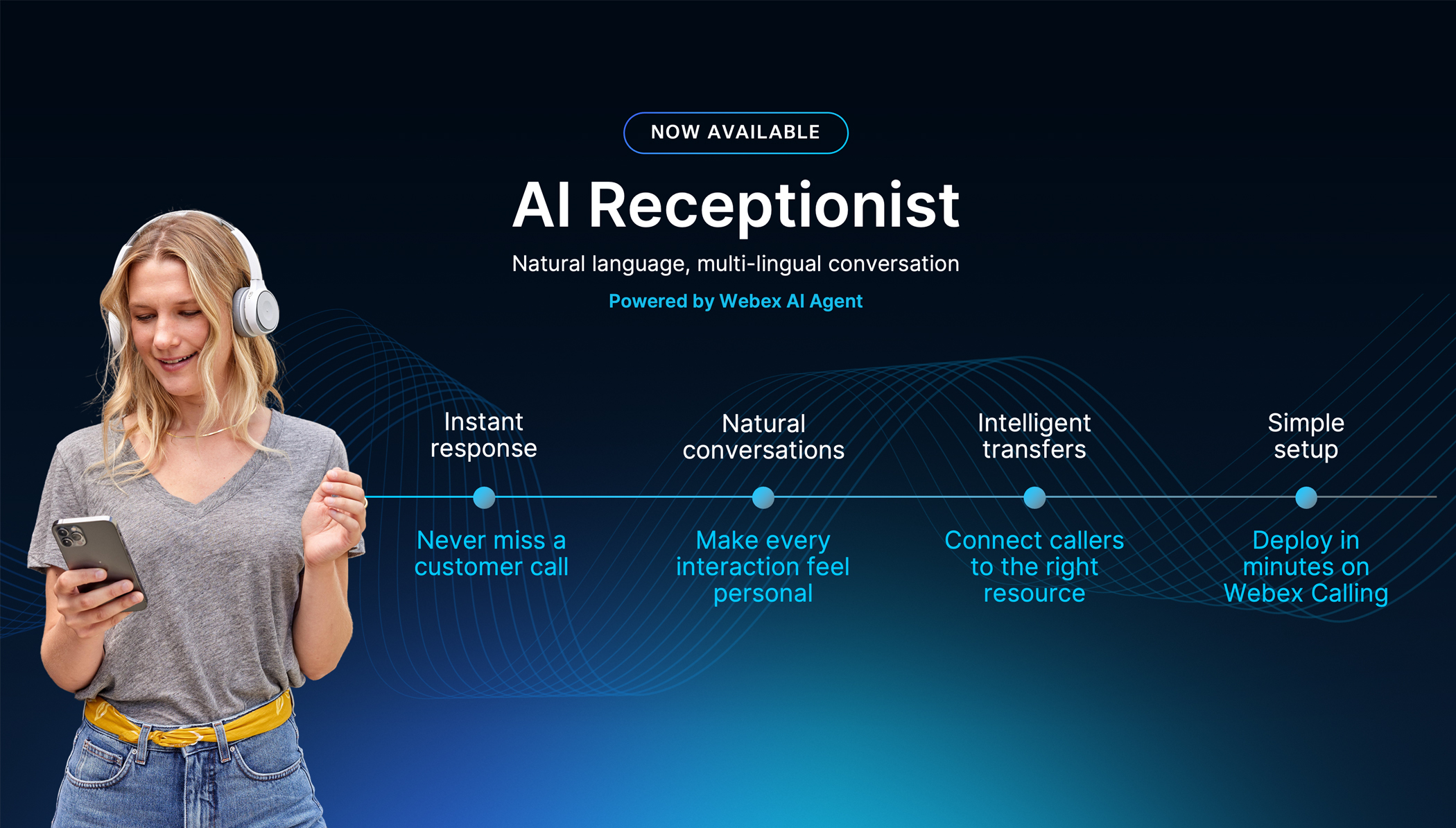
Cisco is helping businesses reimagine the front-office experience with AI Receptionist for Webex Calling, now generally available to customers worldwide. As part of the Webex Calling AI-powered caller journey, AI Receptionist helps businesses create smarter first interactions by answering routine questions, understanding caller intent, and connecting callers to the right next step.
A Smarter Front Desk
For many businesses, the front desk is the first point of contact for customers, patients, guests, or clients. As customer expectations rise and staffing remains tight, businesses need a better way to answer routine calls without sacrificing service quality.
AI Receptionist helps businesses deliver a more responsive, efficient, and consistent caller experience. Powered by AI, it uses natural, conversational speech to answer questions, understand caller intent, and complete tasks such as transferring calls.
Built for Webex Calling customers and powered by Webex AI Agent, AI Receptionist helps handle routine interactions and intelligently route callers to the right resource. This gives employees more time to focus on the moments that require human expertise, empathy, judgment, creativity, and personal connection.
Get Started in Minutes
AI Receptionist is designed as a turnkey solution built into Webex Calling, helping customers avoid the friction of deploying another disconnected system. Because it uses the calling settings customers already manage in Control Hub, including locations, phone numbers, call queues, users, and routing destinations, administrators can deploy and manage AI Receptionist through a guided setup experience in just a few minutes.
During setup, administrators can configure key elements that shape the caller experience, including:
- Location and phone number: Assign AI Receptionist to an existing location and connect it to a Webex Calling phone number, making it easy to deploy within the calling environment customers already use.
- Language and voice: Select the language and voice callers will hear, helping create a more natural and appropriate experience for each business, location, or audience.
- Guidelines: Define the goal of the conversation, welcome message, and instructions for how AI Receptionist should interact with callers, so conversations reflect the organization’s tone, brand, policies, and service expectations.
- Knowledge base: Create or select an approved knowledge base from existing business documents, including PDF, DOCX, DOC, TXT, XLSX, XLS, and CSV files, so AI Receptionist can answer questions with business-specific information.
- Default action: Define what should happen when AI Receptionist cannot complete a request or encounters an issue, helping ensure callers always have a clear next step.
- Caller intents: Identify the intents AI Receptionist should recognize and use for routing, such as sending a caller asking about a recent purchase to the support queue.
The result is a smarter front-office experience that can answer common questions, reflect business policies and tone, route callers based on intent, and deliver consistent, reliable service across locations, departments, and use cases.
Visibility Through Reporting and Analytics
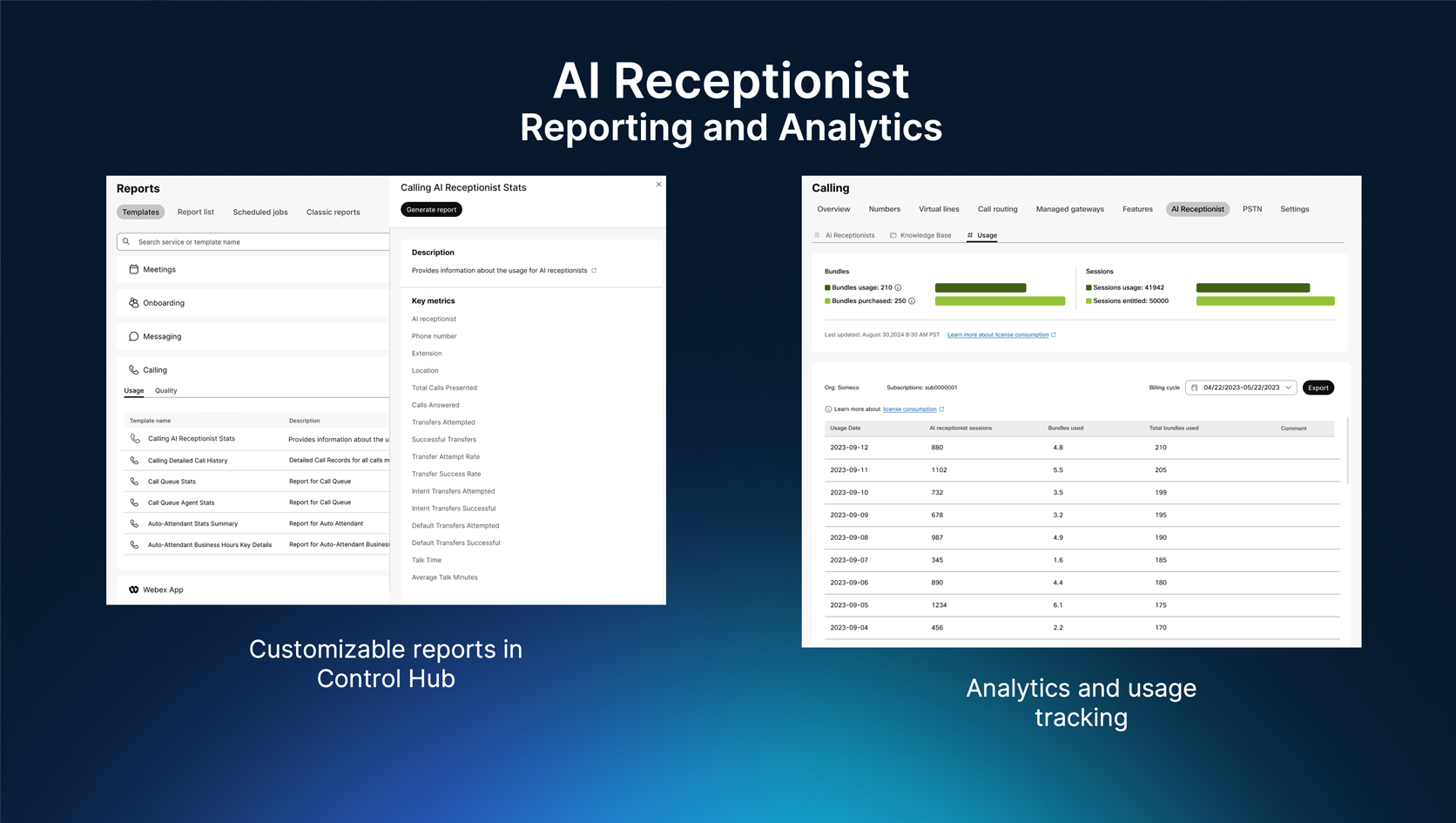
AI Receptionist gives administrators visibility into usage, consumption, and performance. In Control Hub, businesses can access reports to understand how calls are being handled, track AI Receptionist session and bundle consumption, review historical usage across billing cycles, and monitor usage by day.
These insights can help organizations optimize their AI Receptionist configuration, improve knowledge base content, and better understand how callers are interacting with the service.
Flexible Licensing for Webex Calling Customers
AI Receptionist is available as an organization-level add-on for Webex Calling customers. Each AI Receptionist includes a 250-minute bundle for $100.
Organizations can deploy up to 100 AI Receptionist instances across locations, departments, or use cases. Minute entitlements are pooled across all instances, making it easier to manage usage across the organization instead of tracking each AI Receptionist separately.
If usage exceeds the included minutes, additional 250-minute bundles are automatically added at $115 per bundle.
What’s Next for AI Receptionist
As AI Receptionist continues to evolve, Cisco is focused on adding new capabilities that help businesses create more natural caller experiences, automate front-office work, and turn more interactions into completed outcomes. Areas of continued innovation include:
- Expanded Language Support: Hindi, Kannada, Gujarati, Marathi, Hinglish, Japanese, Korean, Vietnamese, Italian, German, Polish, Hungarian, Bulgarian, Portuguese (Brazil), and Spanish (Spain and Mexico), with more languages to come.
- Call Transfer Summaries: Provide employees with conversation context before they answer a transferred call.
- Transfer by Name: Allow callers to reach the right person using natural voice interaction.
- Intent-Based Fulfillment via MCPs: Enable AI Receptionist to complete actions such as appointment scheduling and lead capture.
- Compliance-Focused Call Recording: Support policy-based recording for organizations with compliance requirements.
- Call Analytics: Help organizations measure performance, understand caller interactions, and optimize the caller experience.
- Usage Capping: Give administrators more control over AI Receptionist consumption and capacity planning.
Availability is planned for Q3 calendar 2026, with timing to be confirmed closer to release.
The Future of the AI-Powered Front Office
AI Receptionist for Webex Calling is a core piece of Cisco’s AI Agents for Collaboration strategy, which brings AI-powered automation into the flow of work across voice, video, and digital interactions. It represents the power of pre-built agents that are simple to configure, integrated with Webex Calling, and ready to automate routine front-office interactions. Beyond pre-built agents, AI Agents for Collaboration also enable businesses to create custom agents that complement solutions like AI Receptionist, extending automation to the workflows, systems, and use cases that matter most.
Contact us to schedule a demo of AI Receptionist and start building a smarter front-office experience today.
Learn more:
About The Authors